
Areíto
A ceremonial song and group dance of the Caribbean Taíno people.
The areíto is a communal song and dance ceremony of the Taíno people across the Caribbean. Held in village plazas to honour ancestors, leaders, and deities, it combines recited histories with collective movement led by a dance master and accompanied by flutes, drums, and rattles.
Watch it dancedShare on WhatsApp
- Served as an oral history method to commemorate Taíno ancestors, gods, and chiefs without written script.
- Led by a male or female dance master who guided complex call-and-response singing and movement.
- Dancers often linked into lines with hands on shoulders and wore rattles tied to their bodies.
- Organized by chiefs in village dance courts bordered by earth banks and carved cemi stones.
What is Areíto?
An areíto was a ceremonial tradition combining chanted poetry, instrumental music, and choreographed dance among Indigenous Taíno communities. Gathered in open village plazas or specially prepared earthen dance courts, participants performed under the guidance of a designated dance master. The ritual brought together entire villages, and sometimes travelers from neighboring settlements, into a shared performance. A leader sang verses and initiated physical phrases, which the broader assembly echoed in a structured call-and-response format. As dancers stepped in unison, the rhythms of hollow wooden drums, shell horns, and seed-filled rattles filled the air, turning communal gatherings into vital enactments of spiritual lore and shared tribal memory.
Where does Areíto come from?
The areíto developed among the Taíno populations inhabiting the Caribbean, particularly across the islands of Hispaniola and Puerto Rico. Taíno society grew from ancestral migrations from South America and ancient regional groups. Because the society did not use a written script, sung dances functioned as an essential method for preserving history. European chroniclers, including Ramón Pané and Bartolomé de las Casas, documented these performances during early colonial contact in the late fifteenth and early sixteenth centuries. Observers noted that the practice preserved records of ancient chiefs, historic battles, divine deeds, and essential community customs across generations.
How is Areíto danced?
Choreography in an areíto was coordinated and exact. A male or female dance director stood at the front to direct the steps and chant the phrases. Participants moved in large assemblies, frequently arranging themselves into straight lines while resting their hands upon the shoulders of their neighbors. The entire formation responded to the director through matching physical motions and vocal rejoinders. The dancing required careful synchronisation across the ensemble. Specific performances closed with formal gestures, such as dancers dropping to their knees before guests or community leaders after executing elaborate movement patterns across the outdoor dance arena.
Areíto, drawn
The music of Areíto
Singing formed the foundation of the areíto, with memorised verses recited aloud to drive the rhythm. Musical accompaniment relied on a diverse assortment of percussive and wind instruments. Musicians beat hollowed log drums and shook wooden or gourd rattles packed with small stones. Wind melodies came from bone whistles, flutes, and horns made from sea shells. Dancers also tied rattle instruments straight onto their bodies, causing every step and turn to create sound.
Costume and what is carried
Participants wore items tailored to the nature of the ritual. Chroniclers described specific instances where women wore white loincloths during ceremonial dances for dignitaries. Dancers often strapped small rattles to their limbs so their motions produced percussive accompaniment. Sacred sculptural objects called cemis, shaped from stone, wood, or clay, were positioned around the dance arena or held during rites, alongside carved ceremonial amulets and symbols of authority.
When and where Areíto is danced
Areítos were organised by village chiefs, known as caciques, and held in public plazas outside their residences. These events marked key milestones such as weddings, funeral rites, periods of recovery following disasters, and harvest thanksgiving ceremonies. Chiefs also convened areítos for political purposes, including wartime negotiations, alliances between neighbouring leaders, or welcoming outside visitors. Some performances were reserved solely for men or women, while others united the entire local population.
Styles of Areíto
Historical accounts recorded two primary categories of areíto. One form focused on solemn historical narratives, recording ancestral feats and divine tales. The other served as festive entertainment, incorporating social celebration, pantomime, and shared feasts. Although rooted in the Taíno culture of the Greater Antilles, Spanish writers also used the term broadly to describe comparable song-and-dance rituals they witnessed among Indigenous populations in Nicaragua and across the wider region.
What Areíto means
For the Taíno, the areíto acted as an oral archive and a sacred link to the divine. Sacred objects representing gods and ancestors, known as cemis, were kept nearby during the dances to lend spiritual sanction to community decisions. Songs carried societal rules and historical memory. Exchanging an areíto was an act of profound trust: teaching a dance and its lyrics to an ally transferred ancestral lineage, prestige, and protective spiritual power.
Questions people ask about Areíto
Where does the areíto come from?
The areíto originated among the Indigenous Taíno communities of the Caribbean, particularly on the islands of Hispaniola and Puerto Rico. Spanish chroniclers also applied the term to similar song-dance ceremonies observed in other regions such as Nicaragua.
When and why was an areíto performed?
Village chiefs organised areítos for major events like marriages, deaths, disaster recovery, and religious thanksgiving. They also served as political tools to cement pacts between leaders, prepare for warfare, recount historical deeds, or provide entertainment during festivals.
Who participated in the dance?
Participation depended on the occasion. Some areítos involved the entire village community with men and women together, while others were performed exclusively by men or women. A designated male or female dance master directed the collective singing and stepping.
What instruments accompanied the areíto?
The dances were driven by vocal chanting alongside drums made from hollow logs, gourd and wooden rattles filled with pebbles, bone flutes, whistles, and shell horns. Performers frequently strapped rattles to their limbs to add percussive sounds as they moved.
Good reading and sources
- Areíto on WikipediaEncyclopedia
- Wikidata recordOpen data
- Videos of Areíto on YouTubeSearch results, not chosen by EveryGhunghroo
The facts on this page come from the Wikipedia article "Areíto", written by its contributors and used under the CC BY-SA 4.0 licence, and from its Wikidata record (CC0). EveryGhunghroo rewrote the text in its own words, with AI assistance, and compares every page with the article to make sure no passage is copied. It may be reused under the same CC BY-SA 4.0 licence with a link back.
It may contain mistakes, and it describes the dance in outline: it is not a lesson. Traditions differ from one teacher, village or family to the next. If something is wrong, tell us. Last refreshed 2026-10-04.
More from Puerto Rico
All the dances of Puerto Rico 🇪🇸 Spain and 5 morePasodoble
A dramatic Spanish partner dance set to march-like music, echoing the bullfightFolk dance · Couple · Group
🇪🇸 Spain and 5 morePasodoble
A dramatic Spanish partner dance set to march-like music, echoing the bullfightFolk dance · Couple · Group
 🇵🇷 Puerto RicoPlena
A Puerto Rican folk dance and music genre born in Ponce around 1900.Folk dance · Group
🇵🇷 Puerto RicoPlena
A Puerto Rican folk dance and music genre born in Ponce around 1900.Folk dance · Group
 🇵🇷 Puerto RicoBomba
A drum-and-dance tradition from Puerto Rico where the dancer leads the drummer in a rhythmic conversation.Folk dance · Circle · Group
🇵🇷 Puerto RicoBomba
A drum-and-dance tradition from Puerto Rico where the dancer leads the drummer in a rhythmic conversation.Folk dance · Circle · Group
 🇹🇹 Trinidad and Tobago and 3 moreCalinda
A Caribbean stick-fighting dance and martial art seen at Trinidad CarnivalWar or martial dance · Group · Circle
🇹🇹 Trinidad and Tobago and 3 moreCalinda
A Caribbean stick-fighting dance and martial art seen at Trinidad CarnivalWar or martial dance · Group · Circle
Its cousins elsewhere
All ritual and sacred dances 🇰🇪 Kenya and 1 moreAdumu
A vertical leaping dance performed by Maasai warriors in a circle to show strength and agility.Folk dance · Circle
🇰🇪 Kenya and 1 moreAdumu
A vertical leaping dance performed by Maasai warriors in a circle to show strength and agility.Folk dance · Circle
 🇿🇼 ZimbabweMbende Jerusarema
A polyrhythmic group dance of the Zezuru, marked by acrobatic hip and waist movementsFolk dance · Group · Line or chain
🇿🇼 ZimbabweMbende Jerusarema
A polyrhythmic group dance of the Zezuru, marked by acrobatic hip and waist movementsFolk dance · Group · Line or chain
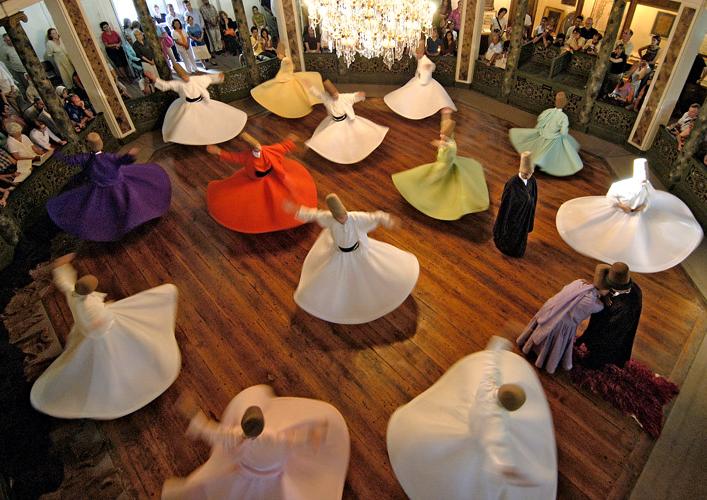 🇹🇷 Turkey and 3 moreSamaسَماع (samā)
A Sufi ritual of listening, prayer, and whirling dance to reach spiritual ecstasyRitual dance · Circle · Group
🇹🇷 Turkey and 3 moreSamaسَماع (samā)
A Sufi ritual of listening, prayer, and whirling dance to reach spiritual ecstasyRitual dance · Circle · Group
 🇮🇳 IndiaBhagavata Mela
An all-night Vaishnavite temple dance-drama from the Kaveri deltaClassical dance · Group
🇮🇳 IndiaBhagavata Mela
An all-night Vaishnavite temple dance-drama from the Kaveri deltaClassical dance · Group