Yein
In its own language: ယိမ်း
A traditional Burmese group dance featuring synchronized body movements to drum beats.
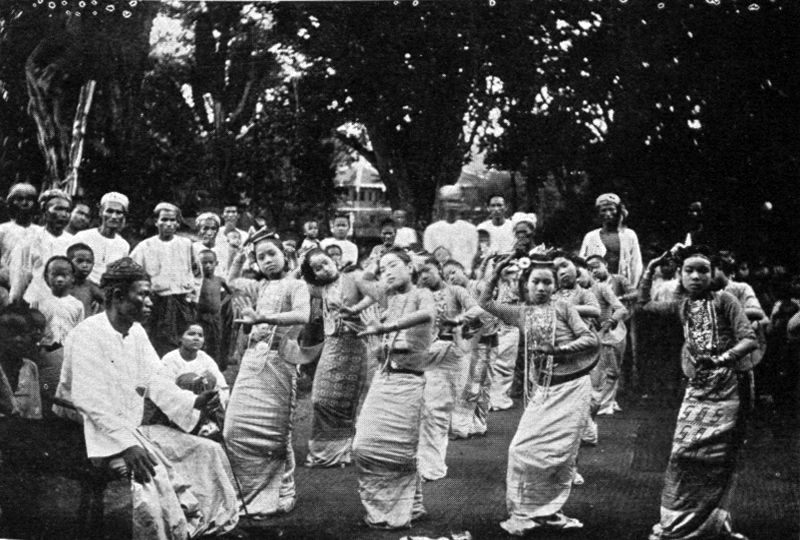
Yein is a folk dance from Myanmar where groups move in time with hsaing waing drums. Dancers coordinate their heads, waists, feet, and hands to create a unified visual rhythm.
Watch it dancedShare on WhatsApp
- Yein is a group dance native to Myanmar.
- Dancers move heads, waists, feet, and hands in sync.
- Accompanied by the hsaing waing traditional orchestra.
- Known as nat aka during the Tagaung era.
- Called myewaing aka during the Konbaung era.
What is Yein?
Yein is a traditional group dance originating in Myanmar. It involves multiple performers moving together in sync. The dancers coordinate their head, waist, foot, and hand movements to match the music. This style highlights collective rhythm rather than individual solo performance.
Where does Yein come from?
The dance has evolved through different historical periods in Myanmar. During the Tagaung era, it was called nat aka, meaning spirit dance. In the Myinsaing era, it became known as ka aka. Later, during the Konbaung era, it was referred to as myewaing aka, or earth circle dance. These names reflect its changing cultural context over centuries.
How is Yein danced?
Dancers perform synchronously, focusing on precise coordination of upper and lower body parts. Movements include swaying the head, bending the waist, stepping with the feet, and gesturing with the hands. The group moves as a single unit, aligning their actions with the musical beats provided by the accompanying instruments.
Yein, drawn
The music of Yein
The dance is accompanied by a traditional Burmese orchestra known as hsaing waing. This ensemble primarily features drums that set the rhythm for the dancers. The beat guides the timing of the coordinated movements, ensuring all participants stay in unison throughout the performance.
Costume and what is carried
The sources do not provide specific details about the costumes, makeup, or props used in Yein. Information regarding traditional dress or accessories associated with this dance form is not available in the provided text.

When and where Yein is danced
Yein is performed as a cultural display within Myanmar. It is presented by groups of dancers who have learned the synchronized steps. The dance serves as a representation of traditional Burmese artistic heritage, often shared during cultural events or performances.
Styles of Yein
The dance has been known by different names across various historical eras in Myanmar. These include nat aka from the Tagaung period, ka aka from the Myinsaing period, and myewaing aka from the Konbaung period. Each name reflects the terminology used during that specific time.
What Yein means
Yein is an integral part of Myanmar's traditional performing arts. It represents the country's historical continuity through its evolving names and styles. The dance preserves cultural memory by maintaining links to past eras such as Tagaung, Myinsaing, and Konbaung.
Questions people ask about Yein
What is Yein?
Yein is a traditional group dance from Myanmar where performers move their heads, waists, feet, and hands in synchronization to music.
What instruments accompany Yein?
The dance is performed to the beats of the hsaing waing, a traditional Burmese orchestra that typically features drums.
Where does Yein come from?
Yein is native to Myanmar (Burma) and has historical roots dating back to the Tagaung, Myinsaing, and Konbaung eras.
What are other names for Yein?
Historically, it was called nat aka (spirit dance), ka aka, and myewaing aka (earth circle dance) during different dynastic periods.
Good reading and sources
- Yein on WikipediaEncyclopedia
- Wikidata recordOpen data
- Videos of Yein on YouTubeSearch results, not chosen by Ghungroo
The facts on this page come from the Wikipedia article "Yein", written by its contributors and used under the CC BY-SA 4.0 licence, and from its Wikidata record (CC0). Ghungroo rewrote the text in its own words, with AI assistance, and compares every page with the article to make sure no passage is copied. It may be reused under the same CC BY-SA 4.0 licence with a link back.
It may contain mistakes, and it describes the dance in outline: it is not a lesson. Traditions differ from one teacher, village or family to the next. If something is wrong, tell us. Last refreshed 2026-10-03.
More from Myanmar
All the dances of Myanmar 🇳🇵 Nepal and 3 moreDeusi-Bhailoदेउसी-भैलो
A house-to-house singing and dancing tradition during Tihar in NepalFolk dance · Group · Procession
🇳🇵 Nepal and 3 moreDeusi-Bhailoदेउसी-भैलो
A house-to-house singing and dancing tradition during Tihar in NepalFolk dance · Group · Procession
 🇨🇳 China and 6 morePeacock dance
A folk dance imitating the peacock, found across South and Southeast AsiaFolk dance · Solo · Group
🇲🇲 MyanmarBurmese dance
Energetic and angular dances from Myanmar, shaped by history and mythClassical dance · Solo · Couple
🇨🇳 China and 6 morePeacock dance
A folk dance imitating the peacock, found across South and Southeast AsiaFolk dance · Solo · Group
🇲🇲 MyanmarBurmese dance
Energetic and angular dances from Myanmar, shaped by history and mythClassical dance · Solo · Couple
Its cousins elsewhere
All folk dances 🇨🇿 Czech Republic and 5 morePolka
A lively partner dance in 2/4 time from 19th-century BohemiaFolk dance · Couple · Circle
🇨🇿 Czech Republic and 5 morePolka
A lively partner dance in 2/4 time from 19th-century BohemiaFolk dance · Couple · Circle
 🇲🇦 MoroccoAhidusⴰⵃⵢⴷⵓⵙ (aḥidous)
A Berber circle dance from Morocco, performed by tribes for celebration and unity.Folk dance · Circle · Line or chain
🇯🇲 JamaicaKumina
A Jamaican spirit-healing dance tradition rooted in Kongo ancestry and drumming.Ritual dance
🇲🇦 MoroccoAhidusⴰⵃⵢⴷⵓⵙ (aḥidous)
A Berber circle dance from Morocco, performed by tribes for celebration and unity.Folk dance · Circle · Line or chain
🇯🇲 JamaicaKumina
A Jamaican spirit-healing dance tradition rooted in Kongo ancestry and drumming.Ritual dance
 🇲🇼 Malawi and 3 moreNyau
A masked ritual dance of the Chewa people in Central and Southern AfricaRitual dance · Group
🇲🇼 Malawi and 3 moreNyau
A masked ritual dance of the Chewa people in Central and Southern AfricaRitual dance · Group