Weddings and family occasions
The first dance
The moment at a wedding party when the newly married couple dance alone and so open the floor for everyone else.
Presented by ClearTrust Free for dancers, travellers and the curious.
At many weddings the dancing does not begin until the couple have danced. They take the empty floor, the guests stand around the edge, and one song is theirs. After it, or partway through, others join. The custom is strongest in Europe and the Americas and has spread widely with the modern wedding reception. It has cousins in many places, some far older.
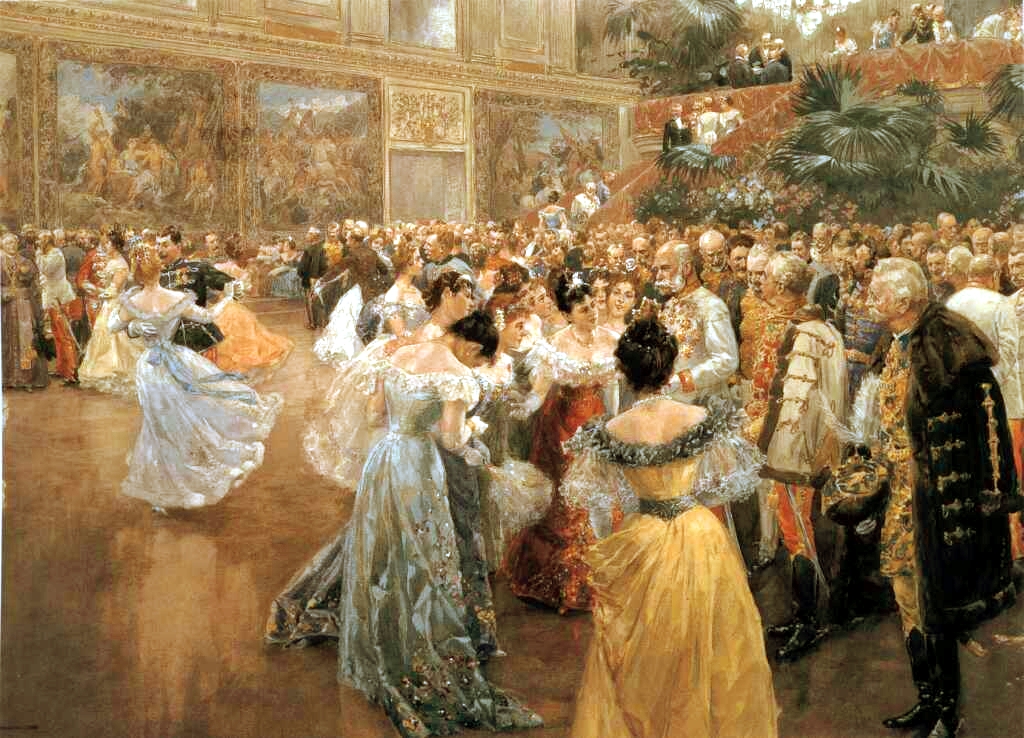
What it is
The first dance is usually a slow partner dance to a song the couple have chosen. It was once almost always a waltz. Now it may be a simple sway, a rehearsed routine or a surprise switch into something fast and funny. It is often followed by dances that honour the families: the bride with her father, the groom with his mother. In some traditions the couple are then joined by the bridal party, and after that the floor is open.
Where it comes from
The practice is borrowed from the formal ball. In European society of the eighteenth and nineteenth centuries, a ball was opened by the hosts or by the guest of highest rank, who led the first dance while others waited. At a wedding ball that honour fell to the bride and groom. As weddings in the twentieth century came to centre on an evening party with a band or DJ, the opening dance stayed as one of its fixed points.
How it works
Other wedding dances turn the couple's dance into a gift. In the money dance, known in Poland, the Philippines, Mexico, parts of the United States and elsewhere, guests take turns dancing a few moments with the bride or groom and pin banknotes to their clothes or drop them in a bag. The money helps the couple start their household. Details differ by country and family, and it is wise to ask what is expected before the day.
If you go
- As a guest, gather at the edge of the floor when the dance is announced.
- Watch, and keep the floor clear until the couple or the host invites others on.
- When the floor opens, join in quickly. An empty floor is hard for the couple.
- At a money dance, have a few notes ready and keep your turn short.
Good manners
- Do not walk across the floor during the couple's dance.
- Take photos from where you stand. Leave the front to the hired photographer.
- Follow the family's lead on customs you do not know.
What is danced
 WaltzA turning couple dance in triple time, first popular in 18th-century Europe
 FoxtrotA smooth ballroom partner dance that travels around the floor to big band music
Also part of it, and being written: First dance, Money dance.
Sources and further reading
Original text by the Ghungroo desk, written with AI assistance and checked against the sources above. Customs vary from place to place. If we have something wrong, tell us.
Photo credits on this page
The small pictures above come from Wikimedia Commons under free licences. Some are cropped to fit.
- Ballroom dance: Johnston, Frances Benjamin, 1864-1952, photographer., Public domain, source
- Waltz: unknown engraver, Public domain, source