Bugg
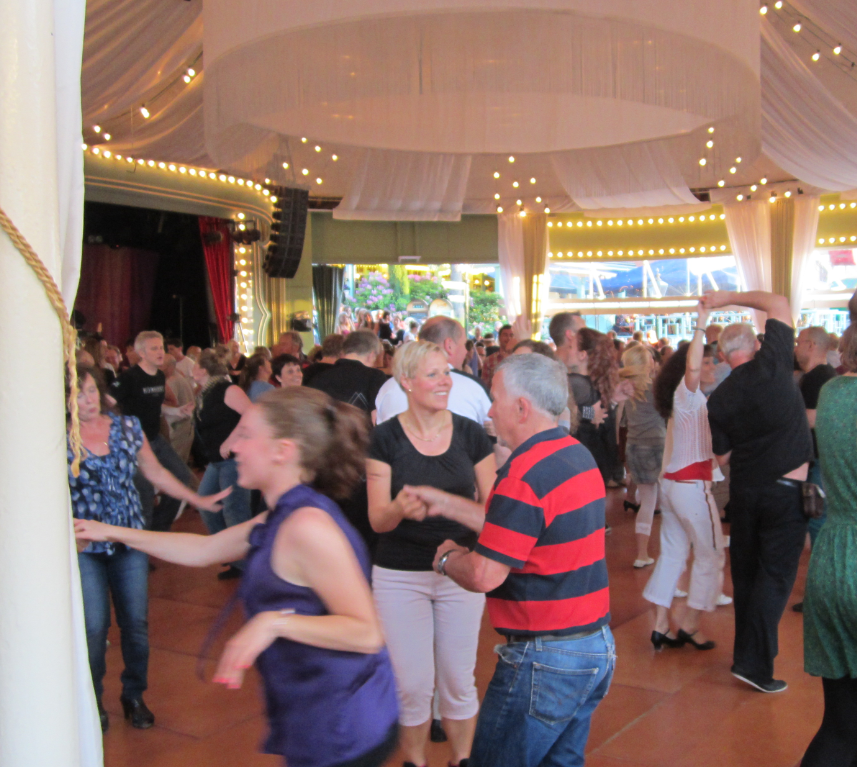
A Swedish partner swing dance danced to dansband music in four-four time.
Bugg is a popular social and competitive partner dance from Sweden. Dancers move together in an improvised style set to the rhythm of dansband music, following a strict lead-and-follow structure without acrobatics.
Watch it dancedShare on WhatsApp
- It is a partner dance belonging to the swing family.
- Competitors must avoid acrobatic moves entirely.
- Double bugg features one leader and two followers.
- Tempo ranges from 120 to 180 beats per minute.
- Nils-Håkan Carlzon helped develop its early movements.
What is Bugg?
Bugg is a lively couple dance rooted in Sweden. It belongs to the swing family and shares close ties with modern jive. Two people dance together, with one leading and the other following. The movement is largely improvised rather than fixed into rigid routines. While it can be performed socially or competitively, the core experience relies on connection between partners. Acrobatic flips are strictly forbidden in formal settings.
Where does Bugg come from?
The dance emerged as a distinct Swedish phenomenon, gaining traction after swing styles like Lindy Hop arrived in the mid-1940s. Nils-Håkan Carlzon is credited as a pioneer who refined its movements at the Nerikes Dance Institute. Competitions started in the mid-1970s with a single freestyle category. By 1983, this split into social and freestyle classes, later merging into the rock style seen today. Its popularity has since spread across the Nordic region.
How is Bugg danced?
Dancers maintain a partner hold while navigating the floor. The leader guides the follower through various steps and turns. The pace varies significantly, ranging from 120 to 180 beats per minute. Despite the speed variations, the structure remains consistent: one person directs the flow while the other responds. The dance avoids complex aerial maneuvers, focusing instead on smooth, connected footwork and timing.
Bugg, drawn
The music of Bugg
The dance is almost exclusively performed to dansband music. This genre provides the rhythmic foundation for the steps. The music operates in a 4/4 time signature. The tempo can shift dramatically during a session, allowing dancers to adjust their energy levels. The beat drives the improvisational nature of the partnership, requiring constant auditory attention from both participants.
Costume and what is carried
Specific traditional attire is not mandated for this dance. Participants typically wear comfortable clothing suitable for active movement and partner work. In competitive environments, dancers may choose outfits that allow freedom of motion while adhering to competition guidelines. The focus remains on the physical interaction rather than elaborate visual presentation.
When and where Bugg is danced
Bugg is primarily a social activity found in Swedish dance clubs and halls. It is also a major competitive discipline within the Swedish Dancesport Federation, which hosts numerous tournaments. The dance serves as a primary form of recreation for many Swedes. It is passed down through dance institutes and local clubs where beginners learn the basic lead-and-follow mechanics.
Styles of Bugg
A specific variant known as double bugg involves one leader dancing with two followers simultaneously. Social bugg focuses on casual participation, while freestyle or rock styles emphasize technical skill and performance. Although regional dialects exist, the fundamental rules and lack of acrobatics remain consistent across all versions throughout the country.
What Bugg means
Bugg holds a significant place in Swedish recreational culture. It is one of the most widely practiced dances in the nation, supported by a large network of competitors and enthusiasts. The dance reflects the adaptation of American swing influences into a distinctly Swedish social format. Its endurance over decades highlights its role as a central pillar of Nordic social dancing.
Questions people ask about Bugg
Where did Bugg originate?
Bugg originated in Sweden. It evolved from American swing styles like Lindy Hop that arrived in the mid-1940s, eventually becoming a distinct Swedish social dance phenomenon.
What kind of music is used for Bugg?
Bugg is danced to dansband music. This genre provides the steady 4/4 rhythm that guides the partners' steps and allows for the varied tempos required by the dance.
Is Bugg a choreographed dance?
No, Bugg is essentially improvised. One partner leads while the other follows, creating unique sequences on the fly rather than performing pre-set routines.
Are there different styles of Bugg?
Yes, styles include social bugg, freestyle, and rock. A variant called double bugg involves one leader dancing with two followers simultaneously.
Good reading and sources
- Bugg on WikipediaEncyclopedia
- Wikidata recordOpen data
- Videos of Bugg on YouTubeSearch results, not chosen by Ghungroo
The facts on this page come from the Wikipedia article "Bugg", written by its contributors and used under the CC BY-SA 4.0 licence, and from its Wikidata record (CC0). Ghungroo rewrote the text in its own words, with AI assistance, and compares every page with the article to make sure no passage is copied. It may be reused under the same CC BY-SA 4.0 licence with a link back.
It may contain mistakes, and it describes the dance in outline: it is not a lesson. Traditions differ from one teacher, village or family to the next. If something is wrong, tell us. Last refreshed 2026-10-04.
More from Sweden
All the dances of Sweden 🇸🇪 SwedenSmå grodorna
A playful Swedish dance around the maypole for Midsummer, miming frog movementsFolk dance · Circle · Group
🇸🇪 SwedenSmå grodorna
A playful Swedish dance around the maypole for Midsummer, miming frog movementsFolk dance · Circle · Group
 🇵🇱 Poland and 3 morePolonaisePolonez, chodzony
A stately walking dance in triple time, opening Polish celebrations and ballsFolk dance · Couple · Procession
🇸🇪 Sweden and 3 morePolska
A Nordic partner dance in triple time, with many local styles and rhythmsFolk dance · Couple
🇸🇪 SwedenHambo
A Swedish couple dance with turning steps and a steady three-beat rhythmFolk dance · Couple
🇵🇱 Poland and 3 morePolonaisePolonez, chodzony
A stately walking dance in triple time, opening Polish celebrations and ballsFolk dance · Couple · Procession
🇸🇪 Sweden and 3 morePolska
A Nordic partner dance in triple time, with many local styles and rhythmsFolk dance · Couple
🇸🇪 SwedenHambo
A Swedish couple dance with turning steps and a steady three-beat rhythmFolk dance · Couple
Its cousins elsewhere
All social dances 🇦🇷 Argentina and 1 moreTango
A partner dance from the Río de la Plata, danced in close or open embraceSocial dance · Couple
🇦🇷 Argentina and 1 moreTango
A partner dance from the Río de la Plata, danced in close or open embraceSocial dance · Couple
 🇮🇳 India and 1 moreFolk dance
Traditional group dances rooted in local life and passed down through generationsFolk dance · Group · Circle
🇮🇳 India and 1 moreFolk dance
Traditional group dances rooted in local life and passed down through generationsFolk dance · Group · Circle
 🇪🇬 Egypt and 3 moreBelly danceرقص شرقي
A Middle Eastern dance focused on hip and torso articulation.Folk dance · Solo
🇪🇬 Egypt and 3 moreBelly danceرقص شرقي
A Middle Eastern dance focused on hip and torso articulation.Folk dance · Solo
 🇦🇷 Argentina and 1 moreArgentine tango
A partner dance from Buenos Aires suburbs, defined by the bandoneon and an intimate embrace.Social dance · Couple
🇦🇷 Argentina and 1 moreArgentine tango
A partner dance from Buenos Aires suburbs, defined by the bandoneon and an intimate embrace.Social dance · Couple