
Tango
A partner dance from the Río de la Plata, danced in close or open embrace
Tango is a partner and social dance that began in the late 1800s in the port districts of Buenos Aires, Argentina, and Montevideo, Uruguay. Born from a mix of African, European, and local influences, it is danced in close or open embrace to music shaped by milonga, habanera, and candombe. Today, tango is recognized worldwide and was added to UNESCO’s Intangible Cultural Heritage list in 2009.
Watch it dancedShare on WhatsApp
- Originated in Buenos Aires and Montevideo in the 1880s
- Influenced by African candombe, habanera, and milonga
- Danced in close or open embrace by couples
- UNESCO Intangible Cultural Heritage since 2009
- Spread from working-class districts to the world
What is Tango?
Tango is a partner dance where two people move together, often in a close embrace, following intricate footwork and expressive movements. It began in the working-class neighborhoods of Buenos Aires and Montevideo, shaped by people of African, European, and local descent. The dance can be intimate or dramatic, with dancers sometimes holding each other chest-to-chest or with space between them. Tango is now danced in many countries, both socially and on stage.
Where does Tango come from?
Tango emerged in the late 19th century along the Río de la Plata, the river border between Argentina and Uruguay. It grew out of gatherings in port areas, influenced by African candombe, Spanish-Cuban habanera, and local milonga. Early on, authorities tried to ban these gatherings, which were associated with Black communities. Tango spread from the slums and bars to all levels of society and then to Europe and beyond. In 2009, UNESCO recognized tango as part of the world’s intangible cultural heritage.
How is Tango danced?
Tango is danced by couples who move in close or open embrace, depending on the style. The lead and follow may connect chest-to-chest or at the hips, and the dance uses both small, syncopated steps and long, sweeping movements. Dancers improvise within the music, using pauses, turns, and intricate footwork. The posture is upright, and the connection between partners is central, whether the embrace is tight or allows more space.
Tango, drawn
The music of Tango
Tango music blends African, European, and local rhythms, drawing from milonga, habanera, and candombe. The music can be slow or fast, and different styles of tango use different tempos and moods. While the sources do not list specific instruments, tango is known for its distinctive sound, which has evolved with the dance. In recent years, electronic and alternative music have also been used for tango.
Costume and what is carried
The sources do not specify a particular costume for tango, but the dance’s evolution from working-class origins to stage performances has led to a range of clothing, from everyday wear to formal dress in theatrical shows. The embrace and movement style can influence what dancers choose to wear, especially in performance settings.


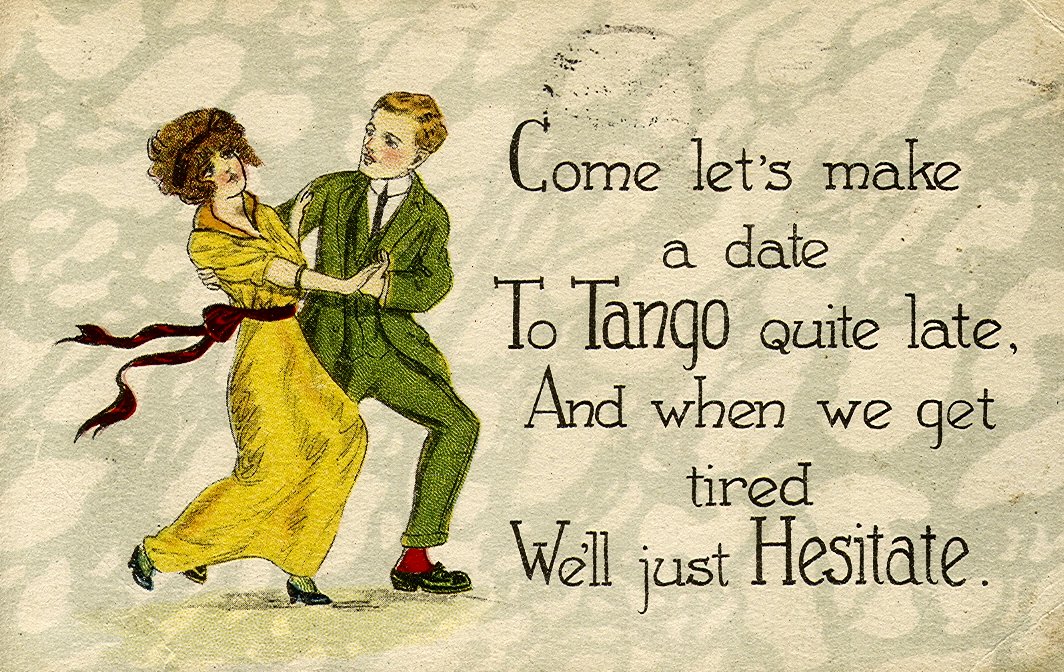

When and where Tango is danced
Tango is danced at social gatherings, festivals, and performances. It began in bars and brothels of port cities and later moved into theaters and dance halls. Today, it is taught and performed worldwide, and in 2009 it was recognized by UNESCO as an important cultural tradition of Argentina and Uruguay.
Styles of Tango
Tango has many styles, shaped by region, era, and setting. Argentine tango, tango milonguero, tango salón, and tango nuevo are some well-known forms. Some styles use a close embrace and small steps, while others allow for open embrace and more elaborate movements. The dance has also inspired ballroom and stage versions, as well as variations in countries like Finland and Brazil.
What Tango means
Tango is a symbol of identity and pride in Argentina and Uruguay. It reflects a mix of African, European, and local cultures, and its history includes periods of controversy and revival. Once seen as scandalous, it is now celebrated as a national and international art form, with UNESCO recognition highlighting its cultural value.
Questions people ask about Tango
Where did tango originate?
Tango began in the late 19th century in the port areas of Buenos Aires, Argentina, and Montevideo, Uruguay, shaped by African, European, and local influences.
When is tango usually danced?
Tango is danced at social gatherings, festivals, and performances. It started in bars and brothels but is now found in dance halls and theaters worldwide.
Who dances tango?
Tango is danced by couples, with both men and women participating. It is open to all and danced by people of different backgrounds.
What makes tango music unique?
Tango music blends rhythms from African candombe, Spanish-Cuban habanera, and local milonga, giving it a distinctive character that matches the dance’s expressive style.
Are there different styles of tango?
Yes, tango has many styles, such as Argentine tango, tango milonguero, tango salón, and tango nuevo, each with its own embrace and movement patterns.
Good reading and sources
- Tango on WikipediaEncyclopedia
- More photos and video on Wikimedia CommonsPhotos and video
- Wikidata recordOpen data
- Videos of Tango on YouTubeSearch results, not chosen by Ghungroo
The facts on this page come from the Wikipedia article "Tango", written by its contributors and used under the CC BY-SA 4.0 licence, and from its Wikidata record (CC0). Ghungroo rewrote the text in its own words, with AI assistance, and compares every page with the article to make sure no passage is copied. It may be reused under the same CC BY-SA 4.0 licence with a link back.
It may contain mistakes, and it describes the dance in outline: it is not a lesson. Traditions differ from one teacher, village or family to the next. If something is wrong, tell us. Last refreshed 2026-10-03.
More from Argentina
All the dances of Argentina 🇦🇷 Argentina and 1 moreArgentine tango
A partner dance from Buenos Aires suburbs, defined by the bandoneon and an intimate embrace.Social dance · Couple
🇦🇷 Argentina and 1 moreArgentine tango
A partner dance from Buenos Aires suburbs, defined by the bandoneon and an intimate embrace.Social dance · Couple
 🇦🇷 Argentina and 1 moreChacarera
A partner dance with foot stomping and handkerchiefs from rural ArgentinaFolk dance · Couple · Group
🇦🇷 Argentina and 1 moreChacarera
A partner dance with foot stomping and handkerchiefs from rural ArgentinaFolk dance · Couple · Group
 🇨🇱 Chile and 3 moreCueca
A partner dance with handkerchiefs, tracing circles in Chile, Bolivia, and PeruFolk dance · Couple · Solo
🇦🇷 Argentina and 3 moreZamba
A slow partner dance from Argentina, with couples circling and waving white handkerchiefsFolk dance · Couple · Circle
🇨🇱 Chile and 3 moreCueca
A partner dance with handkerchiefs, tracing circles in Chile, Bolivia, and PeruFolk dance · Couple · Solo
🇦🇷 Argentina and 3 moreZamba
A slow partner dance from Argentina, with couples circling and waving white handkerchiefsFolk dance · Couple · Circle
Its cousins elsewhere
All social dances 🇮🇳 India and 1 moreFolk dance
Traditional group dances rooted in local life and passed down through generationsFolk dance · Group · Circle
🇮🇳 India and 1 moreFolk dance
Traditional group dances rooted in local life and passed down through generationsFolk dance · Group · Circle
 🇪🇬 Egypt and 3 moreBelly danceرقص شرقي
A Middle Eastern dance focused on hip and torso articulation.Folk dance · Solo
🇪🇬 Egypt and 3 moreBelly danceرقص شرقي
A Middle Eastern dance focused on hip and torso articulation.Folk dance · Solo
 🇸🇪 SwedenSmå grodorna
A playful Swedish dance around the maypole for Midsummer, miming frog movementsFolk dance · Circle · Group
🇸🇪 SwedenSmå grodorna
A playful Swedish dance around the maypole for Midsummer, miming frog movementsFolk dance · Circle · Group
 🇯🇲 JamaicaDancehall
A Jamaican street dance style shaped by sound system parties and fast rhythmsStreet or club dance · Group · Solo
🇯🇲 JamaicaDancehall
A Jamaican street dance style shaped by sound system parties and fast rhythmsStreet or club dance · Group · Solo