Chèo
In its own language: 嘲
A satirical Vietnamese folk musical theatre blending dance, comedy, and village songs
Chèo is a satirical Vietnamese folk dance-theatre tradition rooted in the northern countryside. Peasant troupes perform it on square mats in village squares during seasonal festivals and after harvests, blending comic acting, dance, and lyrical singing to portray ordinary rural life.
Watch it dancedShare on WhatsApp
- Traditional performances take place on woven square mats set up in outdoor village courtyards.
- The small drum sets the rhythm for both dancers and singers during the performance.
- Banned from the royal court in the 15th century, it survived as a folk art of rural peasants.
- Comic clowns use satire and body language to mock corrupt officials and feudal landlords.
What is Chèo?
Chèo is an outdoor folk theatre tradition from northern Vietnam that merges spoken storytelling, humorous acting, folk dance, and vocal melodies. Touring groups set up on simple mats laid across village courtyards to present comic stories to local farming crowds. The plots focus on the daily joys and hardships of ordinary people rather than the exploits of royalty. Actors portray familiar social types such as village scholars, wealthy landowners, teachers, and sharp-witted clowns. The stage action is flexible, allowing artists to adjust their spoken lines, songs, and physical movements in response to the mood and requests of the watching crowd.
Where does Chèo come from?
Tradition traces chèo back to the tenth-century Đinh dynasty in Hoa Lư, Ninh Bình, where a palace dancer named Phạm Thị Trân established the form. It became an established art during the Lý dynasty in the eleventh century and flourished under the Trần dynasty. In the fourteenth century, a captured Mongolian soldier introduced melodic singing into what had previously been spoken sketches. When Emperor Lê Thánh Tông excluded chèo from the royal court in the fifteenth century, it settled firmly into rural villages as peasant entertainment. Local Confucian scholars later wrote down and extended these short comedic parodies into full-length plays.
How is Chèo danced?
Performances center on simple square mats without backdrops or stage machinery. Performers use expressive gestures, physical parody, and dance steps to bring their stock characters to life. Acting styles remain open and improvisational rather than strictly codified. A central comedic figure, the clown or hề, drives the physical humor through caricature, exaggerated movements, and sharp mockery of authorities. Some clown roles rely on physical props like canes to emphasize gestures, while others rely purely on body language and vocal delivery. Performers shift between dancing, speaking, and singing as the emotional tempo of the scene requires.
Chèo, drawn
The music of Chèo
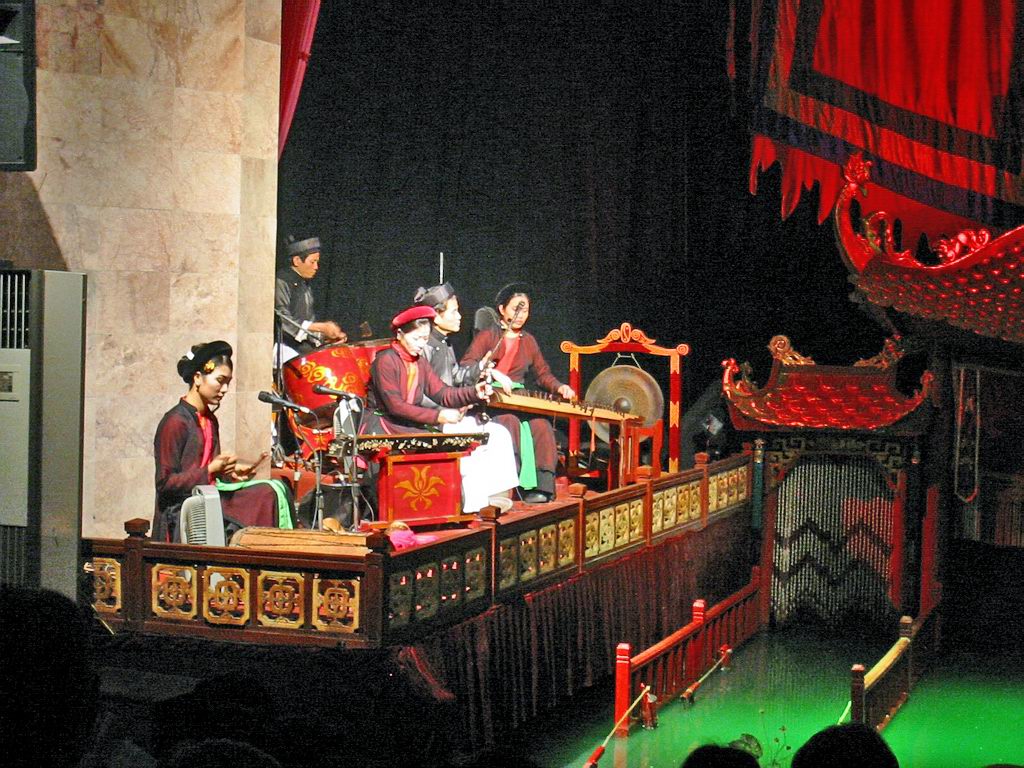
Music forms the core of every show, providing rhythmic drive, emotional atmosphere, and cues for dance routines. The instrumental group relies heavily on string instruments such as the moon lute (đàn nguyệt), the two-stringed fiddle (đàn nhị), and the monochord (đàn bầu). Woodwinds like the bamboo flute (sáo) accompany the singers. Percussion is essential, featuring gongs, cymbals, wooden tocsins, and various drums. The small drum is especially critical, keeping the pace steady for dancers and leading vocalists. Songs follow traditional Vietnamese poetic meters like lục bát.
Costume and what is carried
Costumes in chèo are modest and functional, avoiding the heavy makeup and elaborate garments of court drama. Performers wear garments that reflect rural life and clearly indicate social roles. Clowns appear in two distinct styles: short-shirted clowns, who carry a walking cane to punctuate their comedic timing, and long-shirted clowns, who perform empty-handed. Sparse stage cosmetics allow actors to project readable facial expressions directly to audiences seated nearby.

When and where Chèo is danced
Chèo takes place primarily during rural festivals, summer breaks, and the lunar new year holiday of Tet. In northern agricultural communities, autumn harvest celebrations offer a prime opportunity to gather, thank the gods, and watch performances in the communal đình yard. Semi-amateur ensembles known as gánh hát or phường chèo travel between hamlets, setting up their mats in open village greens or public building courtyards to entertain farmers.
Styles of Chèo
Over time, chèo broadened from its cradle in the Red River delta into the North Central Coast, reaching regions like Nghệ An. Early enactments relied strictly on recitations and spoken parodies before developing into sung drama. In contemporary Vietnam, professional theatre companies also stage indoor productions, expanding the traditional acoustic ensemble by incorporating instruments such as the sixteen-string zither (đàn tranh).
What Chèo means
Chèo plays reflect the moral outlook of northern Vietnamese villagers. Stories celebrate love, fidelity, and friendship, showing gentle students passing imperial exams and virtuous wives reuniting with their husbands. Through the satire of the clown, the plays critique feudal oppression, making fun of mandarins, corrupt officials, and wealthy landlords. The tradition appears in modern popular media as well, such as the 2002 film The Glorious Time in Mê Thảo Hamlet.
Questions people ask about Chèo
Where does chèo come from?
Chèo originated in the Red River delta of northern Vietnam, with its historical homeland in Hoa Lư, Ninh Bình. It developed from ancient village parodies and palace dances of the tenth century.
When and why is chèo performed?
Farming communities stage chèo during village festivals, the Tet holiday, and post-harvest celebrations. It is performed outdoors in communal courtyards to give thanks to the gods for the harvest and provide community entertainment.
What role does dance play in chèo?
Dance is woven directly into the drama alongside song and spoken dialogue. Performers use physical movement, improvisational gestures, and dance steps to bring their characters to life, paced by the rhythm of the small drum.
How does chèo differ from courtly Vietnamese theatre?
Unlike elite court theatre, chèo uses minimal makeup, simple costumes, and no fixed stage scenery. It tells stories about ordinary peasant life and uses comedic characters to poke fun at social hierarchies and feudal rulers.
Good reading and sources
- Chèo on WikipediaEncyclopedia
- Wikidata recordOpen data
- Videos of Chèo on YouTubeSearch results, not chosen by EveryGhunghroo
The facts on this page come from the Wikipedia article "Chèo", written by its contributors and used under the CC BY-SA 4.0 licence, and from its Wikidata record (CC0). EveryGhunghroo rewrote the text in its own words, with AI assistance, and compares every page with the article to make sure no passage is copied. It may be reused under the same CC BY-SA 4.0 licence with a link back.
It may contain mistakes, and it describes the dance in outline: it is not a lesson. Traditions differ from one teacher, village or family to the next. If something is wrong, tell us. Last refreshed 2026-10-04.
More from Vietnam
All the dances of Vietnam 🇨🇳 China and 5 moreLion dance舞獅
A costumed dance that mimics a lion to bring luck and drive away evilFolk dance · Group · Procession
🇨🇳 China and 5 moreLion dance舞獅
A costumed dance that mimics a lion to bring luck and drive away evilFolk dance · Group · Procession
 🇱🇦 Laos and 5 moreRomvong
A slow circle dance for men and women at festivals and gatherings in Southeast AsiaFolk dance · Circle · Group
🇱🇦 Laos and 5 moreRomvong
A slow circle dance for men and women at festivals and gatherings in Southeast AsiaFolk dance · Circle · Group
 🇯🇵 Japan and 5 moreYosakoiよさこい
An energetic group dance from Japan using wooden clappers and modern music.Folk dance · Group
🇻🇳 VietnamChầu văn喝朝文
A northern Vietnamese folk tradition combining trance singing, poetry, and danceFolk dance
🇯🇵 Japan and 5 moreYosakoiよさこい
An energetic group dance from Japan using wooden clappers and modern music.Folk dance · Group
🇻🇳 VietnamChầu văn喝朝文
A northern Vietnamese folk tradition combining trance singing, poetry, and danceFolk dance
Its cousins elsewhere
All folk dances 🇪🇸 Spain and 5 moreWeapon dance
A ceremonial reenactment of combat using swords, staffs, spears, and archery bowsWar or martial dance · Solo · Circle
🇵🇹 Portugal and 1 moreChula
A historic folk dance and challenge tradition found across Portugal and BrazilFolk dance · Solo
🇪🇸 Spain and 5 moreWeapon dance
A ceremonial reenactment of combat using swords, staffs, spears, and archery bowsWar or martial dance · Solo · Circle
🇵🇹 Portugal and 1 moreChula
A historic folk dance and challenge tradition found across Portugal and BrazilFolk dance · Solo
 🇧🇪 Belgium and 5 moreProcessional giant
Huge costumed figures carried and danced in European street processionsFolk dance · Solo · Procession
🇧🇪 Belgium and 5 moreProcessional giant
Huge costumed figures carried and danced in European street processionsFolk dance · Solo · Procession
 🇧🇧 BarbadosBarbados Land-ship
A parade and dance tradition in Barbados, mimicking naval maneuvers on landFolk dance · Group · Procession
🇧🇧 BarbadosBarbados Land-ship
A parade and dance tradition in Barbados, mimicking naval maneuvers on landFolk dance · Group · Procession