Klompendansen
A Dutch folk dance where dancers tap rhythms on the floor while wearing specially made wooden clogs.
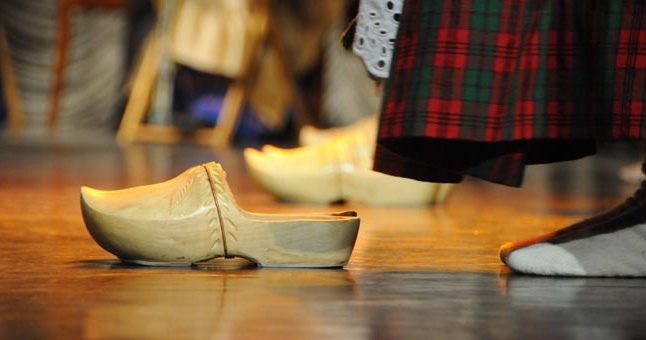
Klompendansen is a traditional folk dance from the Netherlands. Dancers wear lightweight wooden clogs to create rhythmic tapping sounds by striking their toes and heels against the ground. These shoes are part of the standard Dutch traditional costume.
Watch it dancedShare on WhatsApp
- Also called Boerendansen or farmer-dancing.
- Clogs are made lighter with ash wood soles.
- Ankle area is cut lower than traditional designs.
- 500 teens attempted a world record in The Hague in 2006.
- Featured in the ballet La fille mal gardée.
What is Klompendansen?
Klompendansen, also known as Boerendansen, is a folk dance style originating in the Netherlands. The performance relies on the sound of wooden footwear. Dancers wear special clogs that are lighter than historical versions. The soles are crafted from ash wood, and the design is cut lower around the ankle for easier movement. The primary action involves tapping the toes and heels on the floor to produce a distinct rhythm.
Where does Klompendansen come from?
The dance is a traditional style from the Netherlands. It is sometimes referred to as farmer-dancing. The specific clogs used are modified versions of the traditional eight-hundred-year-old klomp design. These modern performance shoes are engineered to be lighter and have a lower ankle cut to facilitate the dancing movements required for the routine.
How is Klompendansen danced?
The core movement involves creating rhythm through footwork. Dancers strike the floor with their toes and heels while wearing the wooden clogs. This tapping generates the musical beat for the dance. The shoes are worn as part of the traditional Dutch costume during these performances. The physical action focuses on the interaction between the wooden soles and the ground surface.
The music of Klompendansen
The music is generated entirely by the dancers themselves. There are no external instruments listed for this folk tradition. The sound comes from the wooden clogs hitting the floor. The rhythm is created by the specific pattern of toe and heel taps performed by the dancers throughout the piece.
Costume and what is carried
Dancers wear traditional Dutch clothing known as klederdracht. A key component is the pair of wooden clogs. These shoes are specifically made lighter than standard historical designs. They feature ash wood soles and a top section that is cut lower at the ankle compared to older styles.
When and where Klompendansen is danced
The dance has been featured in record attempts and ballet productions. In 2006, nearly five hundred teenagers attempted a Guinness World Record for the largest number of clog dancers in The Hague. This event used a ballet version of the dance rather than the folk style. It is also performed in the ballet La fille mal gardée.
Styles of Klompendansen
There is a distinction between the folk version and a ballet adaptation. The ballet version was featured in a large-scale record attempt in The Hague. The choreography for the clog dance in La fille mal gardée was created by Stanley Holden. Frederick Ashton took overall responsibility for the production containing this dance.
What Klompendansen means
The dance is recognized as part of Dutch cultural heritage. It appears in major international records and classical ballet repertoire. The 2006 record attempt in The Hague highlighted its popularity among younger generations. The inclusion in La fille mal gardée shows its integration into formal stage dance traditions.
Questions people ask about Klompendansen
What is Klompendansen?
It is a traditional folk dance from the Netherlands. Dancers wear special wooden clogs to tap rhythms on the floor using their toes and heels. The shoes are part of the traditional Dutch costume and are made lighter for performance.
Where does this dance come from?
Klompendansen originates in the Netherlands. It is a style of folk dance that uses wooden footwear to create musical beats. The term Boerendansen translates to farmer-dancing.
How are the clogs different from regular ones?
Performance clogs are lighter than the traditional eight-hundred-year-old design. They have soles made from ash wood. The top part is cut lower around the ankle to allow for better movement during the dance.
Has it been used in ballet?
Yes, a ballet version appears in La fille mal gardée. The choreography was created by Stanley Holden, with Frederick Ashton taking overall responsibility. This version was used in a 2006 world record attempt in The Hague.
Good reading and sources
- Klompendansen on WikipediaEncyclopedia
- Wikidata recordOpen data
- Videos of Klompendansen on YouTubeSearch results, not chosen by EveryGhunghroo
The facts on this page come from the Wikipedia article "Klompendansen", written by its contributors and used under the CC BY-SA 4.0 licence, and from its Wikidata record (CC0). EveryGhunghroo rewrote the text in its own words, with AI assistance, and compares every page with the article to make sure no passage is copied. It may be reused under the same CC BY-SA 4.0 licence with a link back.
It may contain mistakes, and it describes the dance in outline: it is not a lesson. Traditions differ from one teacher, village or family to the next. If something is wrong, tell us. Last refreshed 2026-10-04.
More from the Netherlands
All the dances of the Netherlands 🇫🇷 France and 4 moreChapelloise
A lively European circle mixer dance where partners change after each phraseFolk dance · Circle · Couple
🇫🇷 France and 4 moreChapelloise
A lively European circle mixer dance where partners change after each phraseFolk dance · Circle · Couple
 🇬🇧 United Kingdom and 2 moreClog dancing
A step dance using wooden-soled footwear to create rhythmic sounds with the feet.Folk dance · Solo · Group
🇬🇧 United Kingdom and 2 moreClog dancing
A step dance using wooden-soled footwear to create rhythmic sounds with the feet.Folk dance · Solo · Group
 🇳🇱 NetherlandsDutch folk dance
Traditional dances of the Netherlands, often performed in groups or couples at social events.Folk dance · Group
🇳🇱 NetherlandsDutch folk dance
Traditional dances of the Netherlands, often performed in groups or couples at social events.Folk dance · Group
Its cousins elsewhere
All folk dances 🇦🇷 Argentina and 1 moreTango
A partner dance from the Río de la Plata, danced in close or open embraceSocial dance · Couple
🇦🇷 Argentina and 1 moreTango
A partner dance from the Río de la Plata, danced in close or open embraceSocial dance · Couple
 🇮🇳 India and 1 moreFolk dance
Traditional group dances rooted in local life and passed down through generationsFolk dance · Group · Circle
🇮🇳 India and 1 moreFolk dance
Traditional group dances rooted in local life and passed down through generationsFolk dance · Group · Circle
 🇧🇷 BrazilCapoeira
A Brazilian martial art that blends dance, acrobatics, and music in a circle gameWar or martial dance · Circle · Solo
🇧🇷 BrazilCapoeira
A Brazilian martial art that blends dance, acrobatics, and music in a circle gameWar or martial dance · Circle · Solo
 🇪🇬 Egypt and 3 moreBelly danceرقص شرقي
A Middle Eastern dance focused on hip and torso articulation.Folk dance · Solo
🇪🇬 Egypt and 3 moreBelly danceرقص شرقي
A Middle Eastern dance focused on hip and torso articulation.Folk dance · Solo