
Kolo
In its own language: Коло
A South Slavic circle dance for groups at weddings and celebrations
Kolo is a traditional circle dance from Serbia, Croatia, and Bosnia and Herzegovina, performed by groups holding hands or waists in a circle, chain, or lines. Danced at weddings, social, and religious events, it features simple steps that can be made more complex by skilled dancers. Each region has its own unique kolos, and traditional costumes are often worn.
Watch it dancedShare on WhatsApp
- Kolo is danced in a circle, chain, or parallel lines
- It is performed at weddings and social ceremonies
- Each region has its own unique kolos
- Recognized by UNESCO as Serbian intangible heritage
- Music is often fast-paced and led by accordion
What is Kolo?
Kolo is a group dance from the South Slavic regions, especially Serbia, Croatia, and Bosnia and Herzegovina. Dancers join hands or link waists, forming circles, chains, or parallel lines. The steps are simple at first, but experienced dancers can add flourishes and complex rhythms. The dance is lively, with most movement in the legs and feet, while the upper body stays mostly still. Groups can be small or very large, and the dance is a familiar sight at community gatherings.
Where does Kolo come from?
Kolo has deep roots among South Slavic peoples and is found in Serbia, Croatia, and Bosnia and Herzegovina. Each region has developed its own versions, and the dance is a marker of local identity. The tradition has influenced neighboring communities, such as Croats in Hungary, where similar dances survive. Kolo was recognized by UNESCO as part of Serbia’s intangible cultural heritage in 2017. The dance has been passed down through generations at social and ceremonial events.
How is Kolo danced?
The basic kolo step is easy to pick up, making it accessible to beginners. Dancers hold hands or waists and move in coordinated patterns, usually in a circle or line. The dance is mostly performed with little movement above the waist, focusing on footwork. Skilled dancers add syncopated steps and other variations to show their expertise. Each region’s kolo has its own steps and style, making it challenging to master every version.
Kolo, drawn
The music of Kolo
Kolo is usually danced to fast-paced music, often led by the accordion. The rhythm is lively, matching the energetic steps of the dancers. The music for kolo has even appeared in classical works, such as Antonín Dvořák’s Slavonic Dances. In many regions, the narodno kolo or drmeš is the most common style, with its own characteristic music.
Costume and what is carried
Traditional costumes are worn for kolo, and these outfits differ from region to region. The clothing reflects local styles and can be quite distinct, even between neighboring areas. Dancers often wear these costumes at social ceremonies and festivals, highlighting the regional identity of each kolo.


When and where Kolo is danced
Kolo is danced at weddings, festivals, religious ceremonies, and other social gatherings. Both men and women may participate together or separately, depending on the tradition. The dance is a central part of celebrations and is learned by watching and joining in at community events. It continues to be an important way to bring people together.
Styles of Kolo
Every region where kolo is danced has at least one unique version, with its own steps and style. Some kolos are simple and accessible, while others are complex and require skill to perform. Even experienced dancers may not know all the regional kolos. The dance has also influenced neighboring countries and communities, leading to related forms.
What Kolo means
Kolo is a symbol of community and local identity in the South Slavic regions. Its inclusion on the UNESCO Intangible Cultural Heritage List for Serbia highlights its cultural importance. The dance is a way for people to connect with their heritage and is a living tradition, still performed at important life events and public celebrations.
Questions people ask about Kolo
Where does kolo come from?
Kolo is a traditional dance from Serbia, Croatia, and Bosnia and Herzegovina, with each region having its own versions. It is especially associated with South Slavic communities.
When is kolo usually danced?
Kolo is performed at weddings, festivals, religious ceremonies, and other social gatherings. It is a key part of celebrations and community events.
Who can dance kolo?
Some kolos are danced by both men and women together, while others are for men or women only. Participation depends on the tradition of the region.
What does kolo look like?
Dancers hold hands or waists and form a circle, chain, or lines. The steps are mostly done with the feet, and the upper body remains still.
What music is used for kolo?
Kolo is usually accompanied by fast-paced music, often led by the accordion. The rhythm matches the lively steps of the dance.
Good reading and sources
- Kolo (dance) on WikipediaEncyclopedia
- More photos and video on Wikimedia CommonsPhotos and video
- Wikidata recordOpen data
- Videos of Kolo on YouTubeSearch results, not chosen by Ghungroo
The facts on this page come from the Wikipedia article "Kolo (dance)", written by its contributors and used under the CC BY-SA 4.0 licence, and from its Wikidata record (CC0). Ghungroo rewrote the text in its own words, with AI assistance, and compares every page with the article to make sure no passage is copied. It may be reused under the same CC BY-SA 4.0 licence with a link back.
It may contain mistakes, and it describes the dance in outline: it is not a lesson. Traditions differ from one teacher, village or family to the next. If something is wrong, tell us. Last refreshed 2026-10-03.
More from Serbia
All the dances of Serbia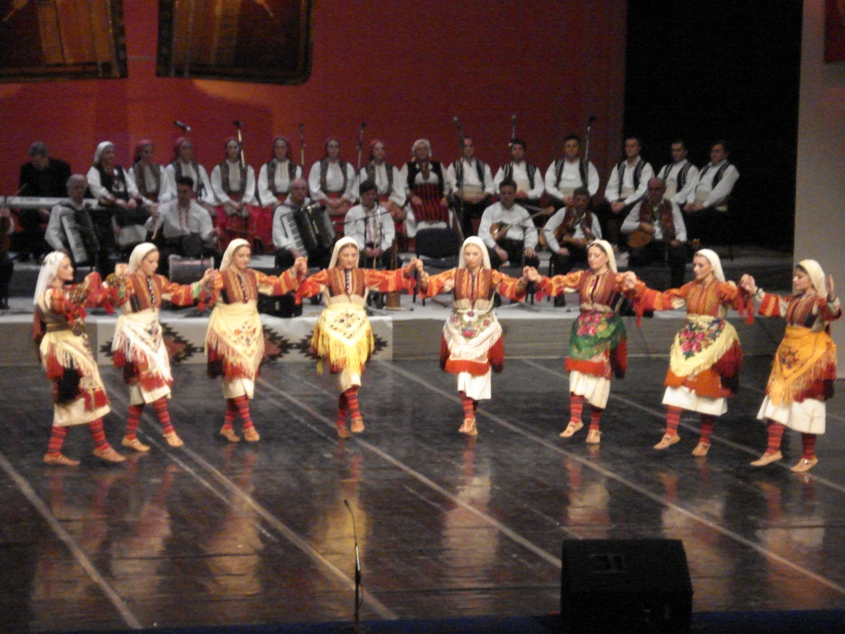 🇷🇴 Romania and 6 moreHora
A group circle dance found across Southeast Europe and in Jewish communitiesFolk dance · Circle · Line or chain
🇷🇴 Romania and 6 moreHora
A group circle dance found across Southeast Europe and in Jewish communitiesFolk dance · Circle · Line or chain
 🇷🇸 Serbia and 4 moreČoček
A Balkan folk dance with shifting rhythms, often played by Romani brass bandsFolk dance · Group
🇧🇬 Bulgaria and 5 moreDodola
A rainmaking procession in Southeast Europe where children dance through villages to call for summer showers.Ritual dance · Procession · Group
🇷🇸 Serbia and 4 moreČoček
A Balkan folk dance with shifting rhythms, often played by Romani brass bandsFolk dance · Group
🇧🇬 Bulgaria and 5 moreDodola
A rainmaking procession in Southeast Europe where children dance through villages to call for summer showers.Ritual dance · Procession · Group
Its cousins elsewhere
All folk dances 🇺🇸 United States and 2 moreContra dance
A social line dance for pairs, led by a caller and set to live folk tunesFolk dance · Couple · Line or chain
🇺🇸 United States and 2 moreContra dance
A social line dance for pairs, led by a caller and set to live folk tunesFolk dance · Couple · Line or chain
 🇨🇱 Chile and 3 moreCueca
A partner dance with handkerchiefs, tracing circles in Chile, Bolivia, and PeruFolk dance · Couple · Solo
🇨🇱 Chile and 3 moreCueca
A partner dance with handkerchiefs, tracing circles in Chile, Bolivia, and PeruFolk dance · Couple · Solo
 🇻🇪 Venezuela and 1 moreJoropo
A fast-paced partner dance of the plains, featuring vigorous footwork and string instruments.Folk dance · Couple
🇻🇪 Venezuela and 1 moreJoropo
A fast-paced partner dance of the plains, featuring vigorous footwork and string instruments.Folk dance · Couple
 🇵🇪 Peru and 3 moreHuayno
A lively Andean partner dance with stamping steps and bright melodiesFolk dance · Couple · Group
🇵🇪 Peru and 3 moreHuayno
A lively Andean partner dance with stamping steps and bright melodiesFolk dance · Couple · Group