
Čoček
A Balkan folk dance with shifting rhythms, often played by Romani brass bands
Čoček is a folk dance and music style that began in the Balkans in the early 1800s. It is closely linked to Romani brass bands and is most often danced at village weddings and celebrations in Serbia, Bulgaria, North Macedonia, Romania, and Albania. The dance features complex rhythms, especially in 9/8 time, and has many local versions.
Watch it dancedShare on WhatsApp
- Čoček began in the Balkans in the early 19th century.
- It is closely linked to Romani brass bands.
- The dance is often in 9/8 time with uneven beat groupings.
- Popular at village weddings and banquets.
- Has many regional and ethnic variations.
What is Čoček?
Čoček is a folk dance and music style from the Balkans, known for its lively group dances and shifting, complex rhythms. It is especially popular among Romani communities and is often performed by brass bands. The dance is seen at weddings, banquets, and festivals, with steps and patterns that change from one region to another. Dancers move in groups, and the music’s uneven beats give the dance a distinctive feel.
Where does Čoček come from?
Čoček developed in the early 1800s, growing out of Ottoman military bands that were active across the Balkans. As these bands spread through Serbia, Bulgaria, North Macedonia, and Romania, the dance took on local characteristics and became part of village life. Romani communities played a key role in keeping the tradition alive, passing it down through generations and adapting it to their own celebrations and styles.
How is Čoček danced?
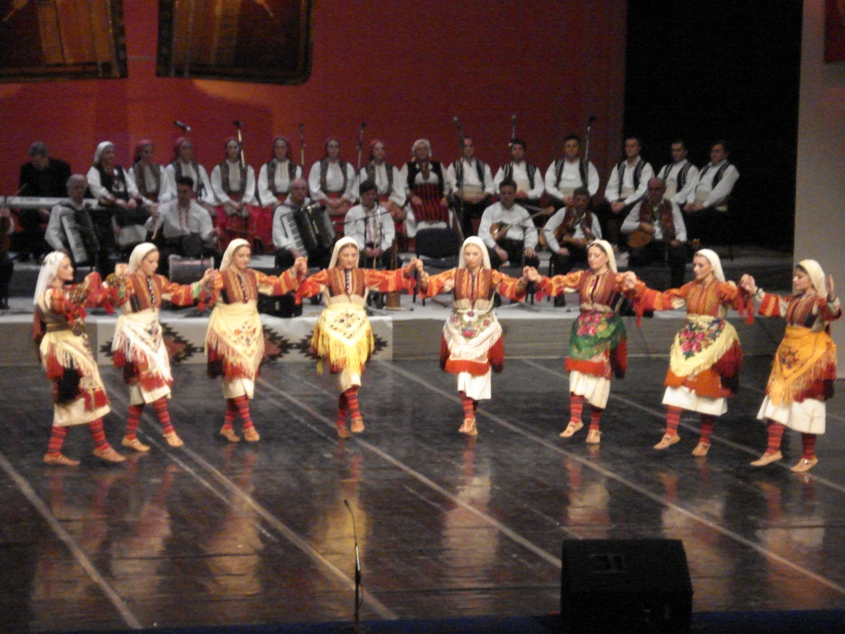
The dance is performed in groups, with dancers following patterns that match the music’s unusual rhythms. The steps often reflect the 9/8 time signature, with movements that can be sharp or smooth depending on the local style. Sometimes, the dance is performed by women, as in the version called 'Kjupurlika' from Titov Veles, but in other places, anyone may join in. The group moves together, responding to the shifting beats.
Čoček, drawn
The music of Čoček
Čoček is closely tied to Romani brass bands, whose lively playing is central to the dance. The music is usually in 9/8 time, sometimes divided into uneven groupings like 2-2-2-3 or 2-2-3-2, giving it a rolling, unpredictable feel. In some areas, musicians use other meters such as 4/4 or 7/8. The melodies are often played on brass instruments, and the music’s energy drives the dancers.
When and where Čoček is danced
Čoček is most often danced at village weddings, banquets, and festivals, especially among Romani and Albanian communities in Kosovo, South Serbia, and Macedonia. The dance is passed down through families and communities, keeping its place in celebrations and gatherings. It is also performed by folk dance groups, both in the Balkans and abroad.
Styles of Čoček
There are many regional and ethnic versions of čoček, each with its own steps and musical patterns. The dance is known by different names in various languages, and styles can differ between villages and communities. In international folk dance circles, melodies like Jeni Jol and Sa Sa are danced as čoček. The form has also influenced musicians outside the Balkans.
What Čoček means
Čoček is an important part of Romani and Balkan cultural life, symbolizing community and celebration. It is especially valued among Muslim Roma and Albanians in certain regions. The dance’s complex rhythms have influenced musicians beyond the Balkans, including jazz composer Dave Brubeck. Čoček remains a living tradition, connecting people to their heritage.
Questions people ask about Čoček
Where does čoček come from?
Čoček comes from the Balkans, especially Serbia, Bulgaria, North Macedonia, Romania, and Albania. It developed in the early 19th century from Ottoman military bands that were active in the region.
Who usually dances čoček?
Čoček is danced by various groups, but it is especially popular among Romani and Albanian communities. In some places, it is performed by women, while in others, anyone may join the dance.
When is čoček performed?
Čoček is most often performed at village weddings, banquets, and festivals. It is a key part of celebrations in many Balkan communities.
What kind of music is used for čoček?
The dance is accompanied by Romani brass bands, playing music in complex rhythms, most often in 9/8 time. The music can also use other meters like 4/4 or 7/8.
Are there different styles of čoček?
Yes, there are many regional and ethnic versions of čoček, each with its own steps and musical patterns. The dance is known by different names in various languages and communities.
Good reading and sources
- Čoček on WikipediaEncyclopedia
- Wikidata recordOpen data
- Videos of Čoček on YouTubeSearch results, not chosen by Ghungroo
The facts on this page come from the Wikipedia article "Čoček", written by its contributors and used under the CC BY-SA 4.0 licence, and from its Wikidata record (CC0). Ghungroo rewrote the text in its own words, with AI assistance, and compares every page with the article to make sure no passage is copied. It may be reused under the same CC BY-SA 4.0 licence with a link back.
It may contain mistakes, and it describes the dance in outline: it is not a lesson. Traditions differ from one teacher, village or family to the next. If something is wrong, tell us. Last refreshed 2026-10-03.
More from Serbia
All the dances of Serbia 🇷🇸 Serbia and 2 moreKoloКоло
A South Slavic circle dance for groups at weddings and celebrationsFolk dance · Circle · Line or chain
🇷🇸 Serbia and 2 moreKoloКоло
A South Slavic circle dance for groups at weddings and celebrationsFolk dance · Circle · Line or chain
 🇷🇴 Romania and 6 moreHora
A group circle dance found across Southeast Europe and in Jewish communitiesFolk dance · Circle · Line or chain
🇧🇬 Bulgaria and 5 moreDodola
A rainmaking procession in Southeast Europe where children dance through villages to call for summer showers.Ritual dance · Procession · Group
🇷🇴 Romania and 6 moreHora
A group circle dance found across Southeast Europe and in Jewish communitiesFolk dance · Circle · Line or chain
🇧🇬 Bulgaria and 5 moreDodola
A rainmaking procession in Southeast Europe where children dance through villages to call for summer showers.Ritual dance · Procession · Group
Its cousins elsewhere
All folk dances 🇺🇸 United StatesSecond line
A New Orleans parade tradition where community members follow brass bands in free-form dance.Folk dance · Procession
🇺🇸 United StatesSecond line
A New Orleans parade tradition where community members follow brass bands in free-form dance.Folk dance · Procession
 🇦🇷 Argentina and 1 moreTango
A partner dance from the Río de la Plata, danced in close or open embraceSocial dance · Couple
🇦🇷 Argentina and 1 moreTango
A partner dance from the Río de la Plata, danced in close or open embraceSocial dance · Couple
 🇮🇳 India and 1 moreFolk dance
Traditional group dances rooted in local life and passed down through generationsFolk dance · Group · Circle
🇮🇳 India and 1 moreFolk dance
Traditional group dances rooted in local life and passed down through generationsFolk dance · Group · Circle
 🇧🇷 BrazilCapoeira
A Brazilian martial art that blends dance, acrobatics, and music in a circle gameWar or martial dance · Circle · Solo
🇧🇷 BrazilCapoeira
A Brazilian martial art that blends dance, acrobatics, and music in a circle gameWar or martial dance · Circle · Solo