
Striptease
An erotic dance in which the performer slowly undresses for an audience
An erotic dance in which a performer slowly undresses, partly or fully, with suggestive movement and much concealment. Danced by strippers or exotic dancers, the modern form grew from 1890s Paris music halls and American burlesque, and is now performed chiefly in strip clubs.
Watch it dancedShare on WhatsApp
- The word 'striptease' was first recorded in 1932.
- H. L. Mencken coined 'ecdysiast', from the word for moulting, at a dancer's request.
- The People's Almanac credits a Paris flea-hunting act of the 1890s as the start of modern striptease.
- Carol Doda gave the first topless go-go dance at San Francisco's Condor Club in June 1964.
- At the Windmill Theatre, censorship law kept nude performers still, as living pictures.
What is Striptease?
A striptease is an erotic dance built around one act: the dancer slowly removes her or his clothes. The dancer, usually called a stripper or exotic dancer, works to prolong the undressing, hiding just-bared skin behind hands, fabric or timing, while moving in a sexually suggestive way. The point is the slow reveal, not the nakedness at the end of it. Performances happen on stages in strip clubs, pubs and theatres, and sometimes privately at parties. Some dancers keep moving after the last garment falls; in older acts the performance ended there.
Where does Striptease come from?
Where striptease began is disputed, with dates suggested from ancient Babylonia to twentieth-century America. Old stories carry a stripping thread: the goddess Inanna shed an item at each of seven gates on her way into the underworld, and Salome danced for King Herod, though the seven veils come from Oscar Wilde's 1893 play, not the Bible. Greek and Roman entertainers danced alluringly unclothed. The modern form is credited to a Paris act of the 1890s in which a woman undressed while hunting an imaginary flea. The word itself was first recorded in 1932.
How is Striptease danced?
The dance centres on slow, sensuous undressing. Dancers stretch it out by wearing many layers, or by covering breasts or genitals with hands or clothing the moment they are bared. Movement stays suggestive rather than acrobatic. Audience interaction may feature: watchers call for more clothes to come off, or the dancer steps among them. What is worn shapes the choreography, since the costume determines what can be taken off, and in what order. Older acts ended once undressing finished; today dancers often continue dancing naked.
Striptease, drawn
The music of Striptease
Striptease has long been set to music. An 18th-century account describes aristocratic dancers dropping their clothes while a prince directed the music at a château party. Paris houses such as the Moulin Rouge and Folies Bergère built acts on sophisticated choreography, and after Wilde's play and Richard Strauss's 1905 opera, the seven-veils routine spread through opera, vaudeville, film and burlesque. In America, trapeze artist Charmion's disrobing act was captured on film in 1901.
Costume and what is carried
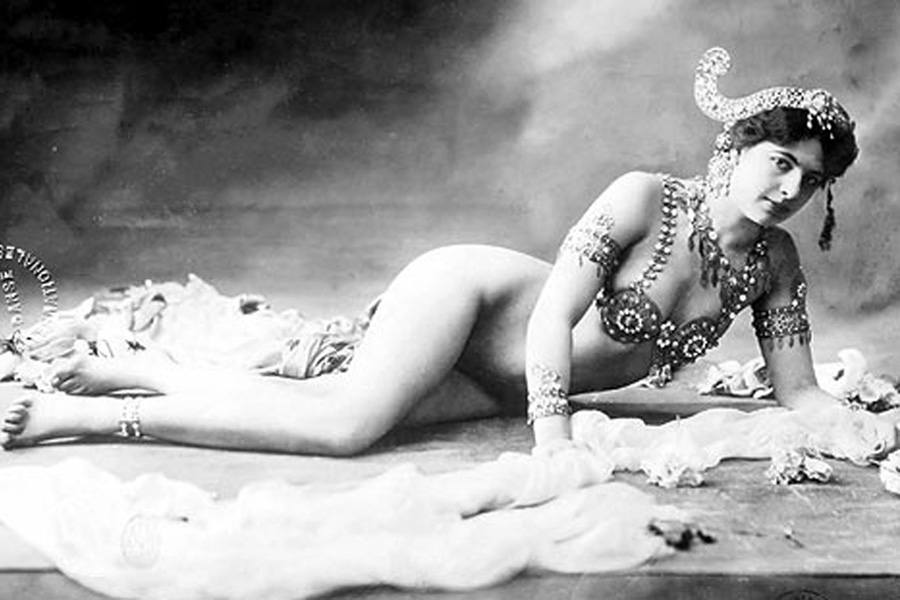
What the dancer wears is itself part of the act, since layers give more to remove. Mata Hari ended her 1905 Paris debut in a jewelled bra and ornaments; Germaine Aymos entered the Moulin Rouge in 1907 wearing three small shells. Paris shows dressed women in glitzy sequins and feathers. In 1930s London the fan dance used fans, the dancer's and her attendants', to conceal a naked body within the letter of censorship law. The seven-veils routine calls for seven veils to shed.


When and where Striptease is danced
Today striptease is most often seen in strip clubs, the venues built around it in Western countries. In Britain it also appears in pubs, and in theatres and music halls. A stripper may be hired for a bachelor or bachelorette party, and partners may use stripping as sexual play between themselves. Venue licensing, national and local laws, and health and safety rules shape what may be shown, and these differ widely, even between parts of the same country.
Styles of Striptease
Three national traditions stand out in the sources. The French one grew in Parisian music halls, from the flea act to Josephine Baker's topless danse sauvage and, by the 1960s, fully nude shows at Le Crazy Horse Saloon. The American one came out of carnivals and burlesque theatres, later adding topless go-go dancing, then full nudity, and lap dancing, pioneered at San Francisco's O'Farrell Theatre in 1980. The British one worked around censorship with living pictures and fan dances, then grew a club scene in Soho.
What Striptease means
Striptease has always drawn restriction. The Christian Church won statutes against the Roman entertainments, and no such practice is reported in medieval Europe. New York's burlesque houses lost it to a legal ruling in 1937; British censorship kept nude performers motionless. Writer H. L. Mencken coined 'ecdysiast', from the word for moulting, when dancer Georgia Sothern asked for a more dignified term, and Gypsy Rose Lee approved. In 1957 Roland Barthes read the Paris striptease as a reassuring ritual in which evil is advertised so it can be contained.
Questions people ask about Striptease
Where does striptease come from?
Its origins are disputed, with dates suggested from ancient Babylonia to twentieth-century America. The modern form is credited to a Paris act of the 1890s in which a woman undressed while searching for a flea. Separate French, American and British traditions grew from there.
When and why is it danced?
It is performed as adult entertainment, regularly at strip clubs, pubs, theatres and music halls, and occasionally at bachelor or bachelorette parties. Some partners also use stripping as private sexual play. In the past the performance ended when the undressing did; dancers today may keep going.
What actually happens in the dance?
The dancer undresses slowly and suggestively, prolonging the reveal with extra layers or by covering just-bared parts with hands or clothes. Audiences may shout for more, or the dancer may approach them. The emphasis falls on the act of undressing, not on being nude.
Is it legal?
Laws vary considerably around the world, and even within one country. Venues are shaped by licensing requirements, national and local laws, and health and safety rules that may forbid full nudity. New York's burlesque houses lost striptease to a legal ruling in 1937.
Who are its famous performers?
Gypsy Rose Lee and Sally Rand headlined American burlesque; Mata Hari debuted in Paris in 1905; Josephine Baker danced topless at the Folies Bergère. H. L. Mencken coined 'ecdysiast' for Georgia Sothern, and Gypsy Rose Lee approved of the word.
Good reading and sources
- Striptease on WikipediaEncyclopedia
- More photos and video on Wikimedia CommonsPhotos and video
- Wikidata recordOpen data
- Videos of Striptease on YouTubeSearch results, not chosen by Ghungroo
The facts on this page come from the Wikipedia article "Striptease", written by its contributors and used under the CC BY-SA 4.0 licence, and from its Wikidata record (CC0). Ghungroo rewrote the text in its own words, with AI assistance, and compares every page with the article to make sure no passage is copied. It may be reused under the same CC BY-SA 4.0 licence with a link back.
It may contain mistakes, and it describes the dance in outline: it is not a lesson. Traditions differ from one teacher, village or family to the next. If something is wrong, tell us. Last refreshed 2026-10-03.
More from France
All the dances of France 🇮🇹 Italy and 2 moreBallet
A highly technical stage dance with its own steps and styles, shaped in France and RussiaClassical dance · Solo · Group
🇮🇹 Italy and 2 moreBallet
A highly technical stage dance with its own steps and styles, shaped in France and RussiaClassical dance · Solo · Group
 🇮🇹 Italy and 3 moreClassical ballet
A formal stage dance using turnout, pointe work and precise, flowing movementClassical dance · Solo · Group
🇮🇹 Italy and 3 moreClassical ballet
A formal stage dance using turnout, pointe work and precise, flowing movementClassical dance · Solo · Group
 🇺🇸 United States and 5 moreContact Improvisation
A partner dance built on touch and shared weight, created in the United States during the early 1970s.Social dance · Couple
🇺🇸 United States and 5 moreContact Improvisation
A partner dance built on touch and shared weight, created in the United States during the early 1970s.Social dance · Couple
 🇮🇱 Israel and 5 moreJewish dance
Dances and dance traditions across Jewish communities and celebrationsFolk dance · Circle · Group
🇮🇱 Israel and 5 moreJewish dance
Dances and dance traditions across Jewish communities and celebrationsFolk dance · Circle · Group
Its cousins elsewhere
All ballet and concert dance 🇦🇷 Argentina and 1 moreArgentine tango
A partner dance from Buenos Aires suburbs, defined by the bandoneon and an intimate embrace.Social dance · Couple
🇦🇷 Argentina and 1 moreArgentine tango
A partner dance from Buenos Aires suburbs, defined by the bandoneon and an intimate embrace.Social dance · Couple
 🇺🇸 United StatesTap dance
A percussive dance using metal-soled shoes to create rhythms on the floorFolk dance · Solo · Group
🇺🇸 United StatesTap dance
A percussive dance using metal-soled shoes to create rhythms on the floorFolk dance · Solo · Group
 🇺🇸 United StatesContemporary dance
A stage dance style blending ballet, modern, and many other influencesConcert dance · Solo · Group
🇺🇸 United StatesContemporary dance
A stage dance style blending ballet, modern, and many other influencesConcert dance · Solo · Group
 🇺🇸 United StatesJazz dance
A performance style born in African American communities that blends improvisation with theatrical movement.Concert dance · Solo · Couple
🇺🇸 United StatesJazz dance
A performance style born in African American communities that blends improvisation with theatrical movement.Concert dance · Solo · Couple