Social dance nights
Bal folk
A relaxed European dance night to live folk music, mixing couple dances with circles and chains anyone can join.
Presented by ClearTrust Free for dancers, travellers and the curious.
A bal folk is a folk ball. Musicians play traditional dance tunes from France and its neighbours on fiddle, accordion, hurdy-gurdy and bagpipes, and a room of people dances. Nobody wears costume and nothing is staged. Some dances are for couples, some for the whole hall holding hands. It is among the easiest dance scenes in Europe for a stranger to walk into.

What it is
The repertoire is wide. Couple dances include the waltz, the mazurka, the polka and the scottish, a gentle relative of the polka. From central France comes the bourrée, danced facing a partner without touching. From Brittany come line and circle dances such as the an dro. There are also mixers, where you change partner every round, and so meet half the room. Bands announce each dance, and people choose whether to join or to sit and listen.
Where it comes from
The scene grew out of the folk revival of the 1970s, when young musicians in France went to record older players and singers in the countryside and then brought the tunes back to towns. Dancing followed the music. Similar movements took root in Belgium, the Netherlands, Italy and Germany. Since then the style has kept changing. Musicians write new tunes, and the slow, close mazurka danced at many balls today is a modern development, not a museum piece.
How it works
An evening often starts with a workshop that teaches three or four dances. Then one or two bands play sets of about an hour each. For couple dances, anyone may invite anyone, whatever their gender. For chains and circles you simply walk up and join the end of the line. Summer brings festivals where people camp and dance for days on outdoor wooden floors. The biggest draw dancers from across the continent.
If you go
- Arrive for the workshop. It is usually included in the entry price.
- Start with the circle and chain dances, where you can copy your neighbours.
- Ask someone to dance a waltz or scottish and say you are new.
- Listen for the band naming the dance before each tune.
Good manners
- Join a chain at its end, not in the middle.
- In couple dances, agree on how close to hold. Closeness is offered, not assumed.
- Leave room for others. On a full floor, travel with the flow of the room.
- Stay quiet during slow tunes. The music is acoustic and people come to hear it.
What is danced
 BourréeA lively French dance in double or triple time, once found in both villages and courts
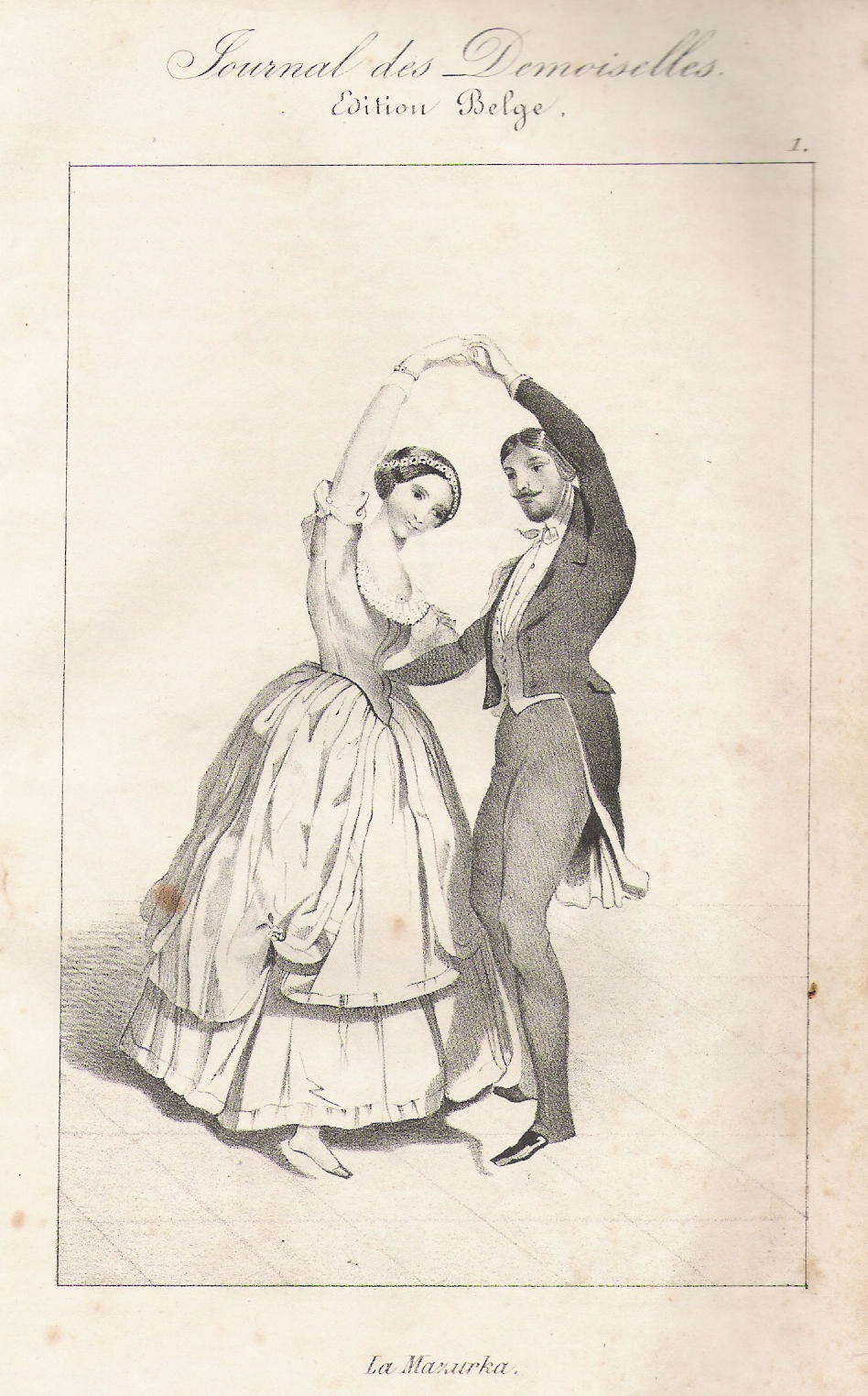 MazurkaA lively Polish folk dance in triple time, known for its shifting accents
 SchottischeA partnered country dance with sidesteps and turns, found across Europe and the Americas
 PolkaA lively partner dance in 2/4 time from 19th-century Bohemia
 WaltzA turning couple dance in triple time, first popular in 18th-century Europe
 An droA Breton circle dance with linked pinkies and swaying arms
 Circle danceA group dance in a circle or curved line, joined by hand and led around the floor
Sources and further reading
Original text by the Ghungroo desk, written with AI assistance and checked against the sources above. Customs vary from place to place. If we have something wrong, tell us.
Photo credits on this page
The small pictures above come from Wikimedia Commons under free licences. Some are cropped to fit.
- Mazurka: Huster, Public domain, source
- Polka: Chaffee A-ii, Public domain, source
- Bourrée: Pierre André Leclercq, CC BY-SA 4.0, source
- Farandole: Hans Thoma, Public domain, source
- An dro: Man vyi, Public domain, source
- Schottische: Javier Perez Montes, CC BY-SA 4.0, source
- Waltz: unknown engraver, Public domain, source