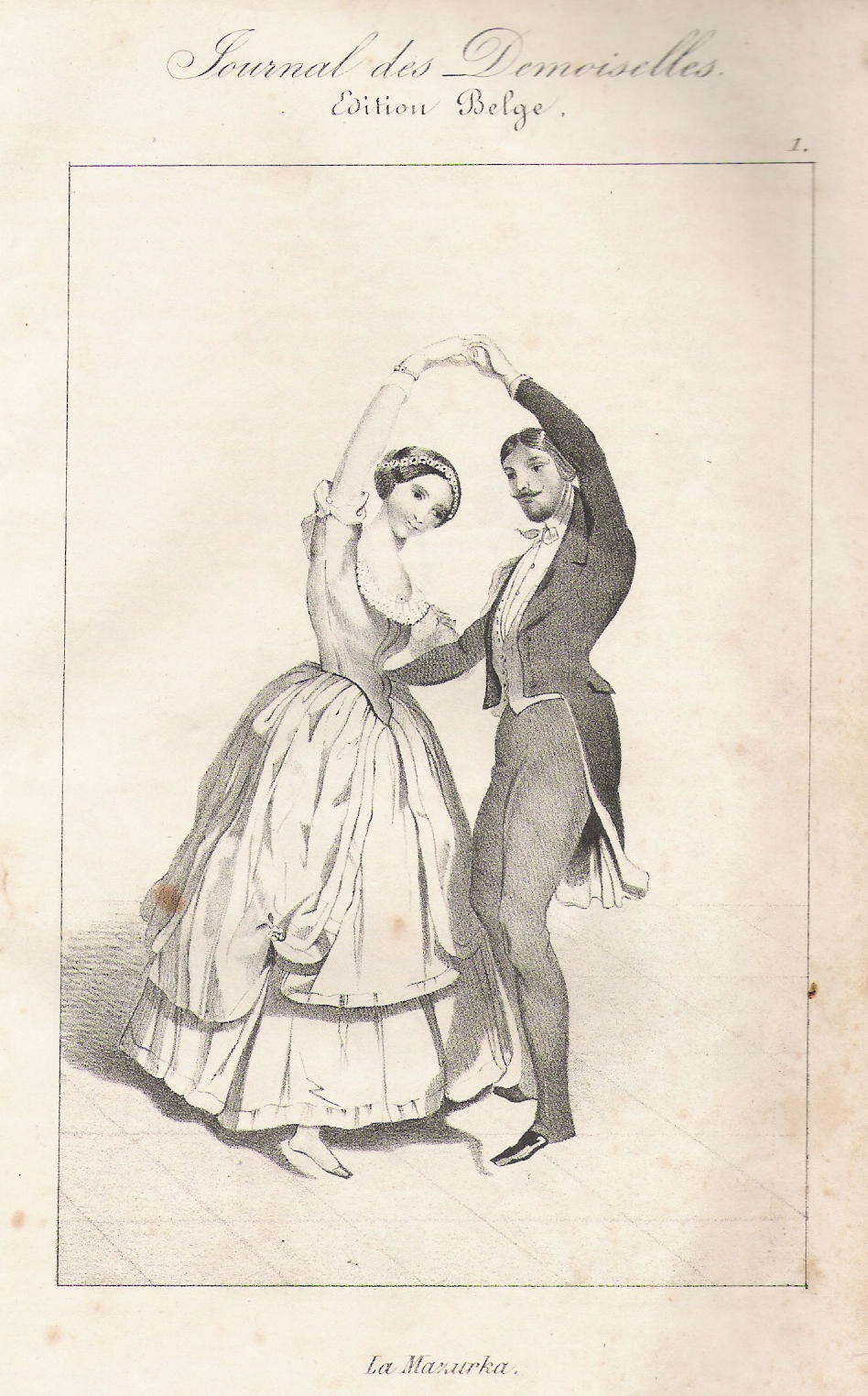
Mazurka
A lively Polish folk dance in triple time, known for its shifting accents
Mazurka is a Polish folk dance in triple metre, marked by lively tempo and accents on the second or third beat. Originating in Mazovia, it spread across Europe and beyond in the 19th century, becoming popular in ballrooms and inspiring many classical composers. Today, it appears in folk and social dance traditions in places such as Ireland, Cape Verde, and the Philippines.
Watch it dancedShare on WhatsApp
- Mazurka began in Mazovia, Poland, from three local dances
- Accents fall on the second or third beat in triple time
- Chopin wrote 59 mazurkas for solo piano
- Mazurka spread to ballrooms across Europe in the 19th century
- Distinct regional versions exist in Ireland, Cape Verde, and the Philippines
What is Mazurka?
Mazurka is a Polish folk dance and musical form, most often danced in couples or groups. It is set in triple time, with a lively pace and distinctive accents that fall on the second or third beat, giving it a unique, syncopated feel. The dance features energetic steps and sometimes a hop, and its music is played on instruments like the violin, guitar, or piano. Mazurka has influenced both classical music and folk traditions in many countries.
Where does Mazurka come from?
Mazurka comes from the Mazovia region of Poland and is rooted in three local dances: the mazur, kujawiak, and oberek. Each has its own character, from the fast oberek to the slower kujawiak. The dance and its music became widely known in 19th-century Europe, in part through composers like Chopin, who transformed the mazurka into a concert piece. The dance also spread to ballrooms and folk traditions in many countries.
How is Mazurka danced?
Mazurka is danced in triple time, with steps that emphasize the second or third beat. Couples or groups move with lively footwork, often including hops or stamps. The dance can be performed in lines, circles, or as a solo, depending on the tradition. In some versions, the dance is more intimate and gentle, while others keep the energetic hop. The pattern of movement and the relationship between dancers vary by region.
Mazurka, drawn
The music of Mazurka
Mazurka music is in triple metre, usually fast, and marked by strong, shifting accents. The rhythm often features dotted notes, triplets, and trills. In Poland, it is played on folk instruments like violin and guitar, while composers like Chopin wrote mazurkas for piano. In Cape Verde, acoustic bands led by violinists play the mazurka. The music’s lively character invites energetic dancing.
When and where Mazurka is danced
Mazurka is danced at social gatherings, festivals, and performances. In Poland, it was once a staple of village celebrations and later became popular in European ballrooms. In Cape Verde and the Philippines, it remains part of local traditions. In Ireland, it is mainly played in County Donegal. The dance is taught and passed down through community events and music sessions.
Styles of Mazurka
There are many regional and national variations of the mazurka. In France and Belgium, the mazouk is a gentler, more intimate style. In Ireland, the Donegal mazurka has a consistent accent on the second beat. The Mazurka Boholana is a Filipino version. In Cape Verde, the dance is performed with local musical styles. Chopin’s mazurkas are concert pieces, not meant for dancing.
What Mazurka means
Mazurka is a symbol of Polish identity and has influenced music and dance across Europe and beyond. It appears in literature and film, especially in Russia. The dance is part of the cultural heritage of several countries, with each adapting it to local tastes. Chopin’s mazurkas are celebrated in classical music, while folk versions continue to be danced at festivals and social events.
Questions people ask about Mazurka
Where does the mazurka come from?
Mazurka originated in the Mazovia region of Poland, based on local dances called mazur, kujawiak, and oberek.
When is the mazurka danced?
Mazurka is danced at social gatherings, festivals, and performances. In the 19th century, it was popular in European ballrooms and is still part of folk traditions in several countries.
What makes the mazurka's rhythm unique?
The mazurka is in triple metre, with strong accents on the second or third beat, giving it a syncopated feel unlike the waltz.
Who dances the mazurka?
Mazurka is danced by mixed couples or groups, and in some traditions, it can be performed solo.
What instruments are used for mazurka music?
Mazurka music is played on instruments like violin, guitar, and piano, depending on the region and tradition.
Good reading and sources
- Mazurka on WikipediaEncyclopedia
- More photos and video on Wikimedia CommonsPhotos and video
- Wikidata recordOpen data
- Videos of Mazurka on YouTubeSearch results, not chosen by Ghungroo
The facts on this page come from the Wikipedia article "Mazurka", written by its contributors and used under the CC BY-SA 4.0 licence, and from its Wikidata record (CC0). Ghungroo rewrote the text in its own words, with AI assistance, and compares every page with the article to make sure no passage is copied. It may be reused under the same CC BY-SA 4.0 licence with a link back.
It may contain mistakes, and it describes the dance in outline: it is not a lesson. Traditions differ from one teacher, village or family to the next. If something is wrong, tell us. Last refreshed 2026-10-03.
More from Poland
All the dances of Poland 🇨🇿 Czech Republic and 5 morePolka
A lively partner dance in 2/4 time from 19th-century BohemiaFolk dance · Couple · Circle
🇨🇿 Czech Republic and 5 morePolka
A lively partner dance in 2/4 time from 19th-century BohemiaFolk dance · Couple · Circle
 🇵🇱 Poland and 3 morePolonaisePolonez, chodzony
A stately walking dance in triple time, opening Polish celebrations and ballsFolk dance · Couple · Procession
🇵🇱 Poland and 3 morePolonaisePolonez, chodzony
A stately walking dance in triple time, opening Polish celebrations and ballsFolk dance · Couple · Procession
 🇭🇺 Hungary and 5 moreCsárdás
A Hungarian folk dance that begins slowly and ends in a fast spin.Folk dance · Couple · Group
🇭🇺 Hungary and 5 moreCsárdás
A Hungarian folk dance that begins slowly and ends in a fast spin.Folk dance · Couple · Group
 🇵🇱 PolandKrakowiak
A fast Polish partner dance from Kraków, known for its syncopated rhythm and circle formation.Folk dance · Couple · Circle
🇵🇱 PolandKrakowiak
A fast Polish partner dance from Kraków, known for its syncopated rhythm and circle formation.Folk dance · Couple · Circle
Its cousins elsewhere
All folk dances 🇦🇷 Argentina and 1 moreChacarera
A partner dance with foot stomping and handkerchiefs from rural ArgentinaFolk dance · Couple · Group
🇦🇷 Argentina and 1 moreChacarera
A partner dance with foot stomping and handkerchiefs from rural ArgentinaFolk dance · Couple · Group
 🇨🇺 Cuba and 5 moreContradanzacontradanza criolla
A Cuban partner dance with African rhythms that influenced jazz and tangoFolk dance · Couple
🇨🇺 Cuba and 5 moreContradanzacontradanza criolla
A Cuban partner dance with African rhythms that influenced jazz and tangoFolk dance · Couple
 🇦🇷 Argentina and 2 moreChamamé
A partnered folk dance from Argentina blending Guaraní and European roots.Folk dance · Couple
🇦🇷 Argentina and 2 moreChamamé
A partnered folk dance from Argentina blending Guaraní and European roots.Folk dance · Couple
 🇺🇸 United States and 2 moreContra dance
A social line dance for pairs, led by a caller and set to live folk tunesFolk dance · Couple · Line or chain
🇺🇸 United States and 2 moreContra dance
A social line dance for pairs, led by a caller and set to live folk tunesFolk dance · Couple · Line or chain