
Candombe
A drum-driven street dance of African descent in Uruguay and Argentina
Candombe is a music and dance style born in Uruguay from the traditions of liberated African slaves. It features barrel drums played in parades during February carnivals and remains a key part of community identity.
Watch it dancedShare on WhatsApp
- UNESCO listed candombe in 2009 as intangible cultural heritage.
- Three main drums drive the Uruguayan rhythm: chico, repique, and piano.
- Dance origins trace back to enslaved people from the Kongo region.
- Performed annually during the February carnival in Montevideo.
- Argentine version includes singing in archaic African languages.
What is Candombe?
Candombe is a lively musical and dance tradition rooted in the culture of African descendants in South America. Dancers move to the steady pulse of barrel-shaped drums played by large groups in the streets. The choreography is energetic and allows for personal improvisation within a communal framework. It serves as a powerful expression of identity and group cohesion for communities of African descent.
Where does Candombe come from?
The practice began in Angola before being brought to the Americas by enslaved people in the seventeenth and eighteenth centuries. In Uruguay, it developed among freed slaves who gathered on Sundays and holidays to play music and dance. Over time, upper-class citizens adopted elements of the style, sometimes through blackface performances. The tradition faced decline due to migration and racism but has seen revivals in recent decades.
How is Candombe danced?
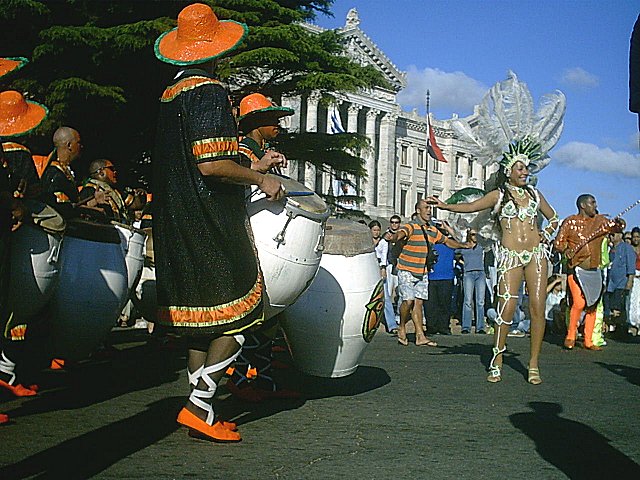
Dancers perform in processions or rows, often wearing drums at their waists with shoulder straps. The footwork is energetic and improvised to match the rhythm. Participants may wear costumes that mock historical slave masters, adding a layer of social commentary to the physical movement. The dance is performed both in private gatherings and public street parades.
Candombe, drawn
The music of Candombe
The sound relies on three main Uruguayan drums: chico for the high rhythmic pulse, repique for improvised embellishments, and piano for the low bass line. Argentine versions use llamador and repicador drums alongside idiophones like taba and mazacalla. Performers strike the wood side of the drums to create a clave pattern. Songs are sung in African languages, Spanish, or a mix of both.
Costume and what is carried
Drummers wear their instruments at waist level using a talig or talí strap. Traditional attire may include masks or outfits representing historical figures from the slavery era. The visual presentation emphasizes the collective nature of the performance, with rows of drummers moving together through city streets.


When and where Candombe is danced
The dance is central to the February carnival in Montevideo, specifically during llamadas and inaugural parades. It is also performed for religious feasts like Saint Baltasar in Argentina and on holidays such as Christmas and New Year's Eve. Historically, it was a Sunday ritual for Afro-Uruguayan communities in neighborhoods like Barrio Sur.
Styles of Candombe
Uruguayan candombe uses three distinct drum types and is recognized as intangible cultural heritage. Argentine candombe employs different drum names and focuses more on vocal-instrumental dialogue. A modern fusion called candombe beat emerged in the late twentieth century, blending traditional rhythms with pop and bossa nova influences.
What Candombe means
UNESCO inscribed candombe in 2009 as a representative element of humanity's intangible heritage. It stands as a symbol of pride for African-descendant communities in Montevideo. Despite periods of invisibility due to social policies, the dance remains a vital tool for preserving history and fostering intergenerational connection.
Days Candombe is danced for
Questions people ask about Candombe
Where did candombe originate?
It originated in Angola and was brought to South America by enslaved Africans in the seventeenth and eighteenth centuries, developing into distinct styles in Uruguay and Argentina.
What instruments are used in candombe?
Uruguayan candombe uses chico, repique, and piano drums. Argentine candombe typically uses llamador and repicador drums, accompanied by idiophones like taba and mazacalla.
When is candombe usually performed?
It is most prominent during the February carnival in Montevideo. It is also danced on religious holidays like Saint Baltasar and historically on Sundays and New Year's Eve.
Is candombe still practiced today?
Yes, it is a living tradition. It is celebrated in Uruguay, Argentina, Paraguay, and Brazil, with modern artists continuing to fuse its rhythms with contemporary music genres.
Good reading and sources
- Candombe on WikipediaEncyclopedia
- More photos and video on Wikimedia CommonsPhotos and video
- Wikidata recordOpen data
- Videos of Candombe on YouTubeSearch results, not chosen by Everydance
The facts on this page come from the Wikipedia article "Candombe", written by its contributors and used under the CC BY-SA 4.0 licence, and from its Wikidata record (CC0). Everydance rewrote the text in its own words, with AI assistance, and compares every page with the article to make sure no passage is copied. It may be reused under the same CC BY-SA 4.0 licence with a link back.
It may contain mistakes, and it describes the dance in outline: it is not a lesson. Traditions differ from one teacher, village or family to the next. If something is wrong, tell us. Last refreshed 2026-10-04.
More from Uruguay
All the dances of Uruguay 🇦🇷 Argentina and 1 moreTango
A partner dance from the Río de la Plata, danced in close or open embraceSocial dance · Couple
🇦🇷 Argentina and 1 moreTango
A partner dance from the Río de la Plata, danced in close or open embraceSocial dance · Couple
 🇦🇷 Argentina and 1 moreArgentine tango
A partner dance from Buenos Aires suburbs, defined by the bandoneon and an intimate embrace.Social dance · Couple
🇦🇷 Argentina and 3 moreBallroom tango
A stylized partner dance developed in Europe and the US from Argentine roots.Ballroom or Latin dance · Couple
🇦🇷 Argentina and 1 moreArgentine tango
A partner dance from Buenos Aires suburbs, defined by the bandoneon and an intimate embrace.Social dance · Couple
🇦🇷 Argentina and 3 moreBallroom tango
A stylized partner dance developed in Europe and the US from Argentine roots.Ballroom or Latin dance · Couple
 🇦🇷 Argentina and 2 moreChamamé
A partnered folk dance from Argentina blending Guaraní and European roots.Folk dance · Couple
🇦🇷 Argentina and 2 moreChamamé
A partnered folk dance from Argentina blending Guaraní and European roots.Folk dance · Couple
Its cousins elsewhere
All folk dances 🇪🇸 SpainFlamenco
A dramatic dance and music tradition rooted in Andalusia's gitano and folk culturesFolk dance · Solo · Group
🇪🇸 SpainFlamenco
A dramatic dance and music tradition rooted in Andalusia's gitano and folk culturesFolk dance · Solo · Group
 🇦🇹 Austria and 4 moreWaltz
A turning couple dance in triple time, first popular in 18th-century EuropeBallroom or Latin dance · Couple
🇦🇹 Austria and 4 moreWaltz
A turning couple dance in triple time, first popular in 18th-century EuropeBallroom or Latin dance · Couple
 🇮🇳 India and 1 moreFolk dance
Traditional group dances rooted in local life and passed down through generationsFolk dance · Group · Circle
🇮🇳 India and 1 moreFolk dance
Traditional group dances rooted in local life and passed down through generationsFolk dance · Group · Circle
 🇪🇬 Egypt and 3 moreBelly danceرقص شرقي
A Middle Eastern dance focused on hip and torso articulation.Folk dance · Solo
🇪🇬 Egypt and 3 moreBelly danceرقص شرقي
A Middle Eastern dance focused on hip and torso articulation.Folk dance · Solo