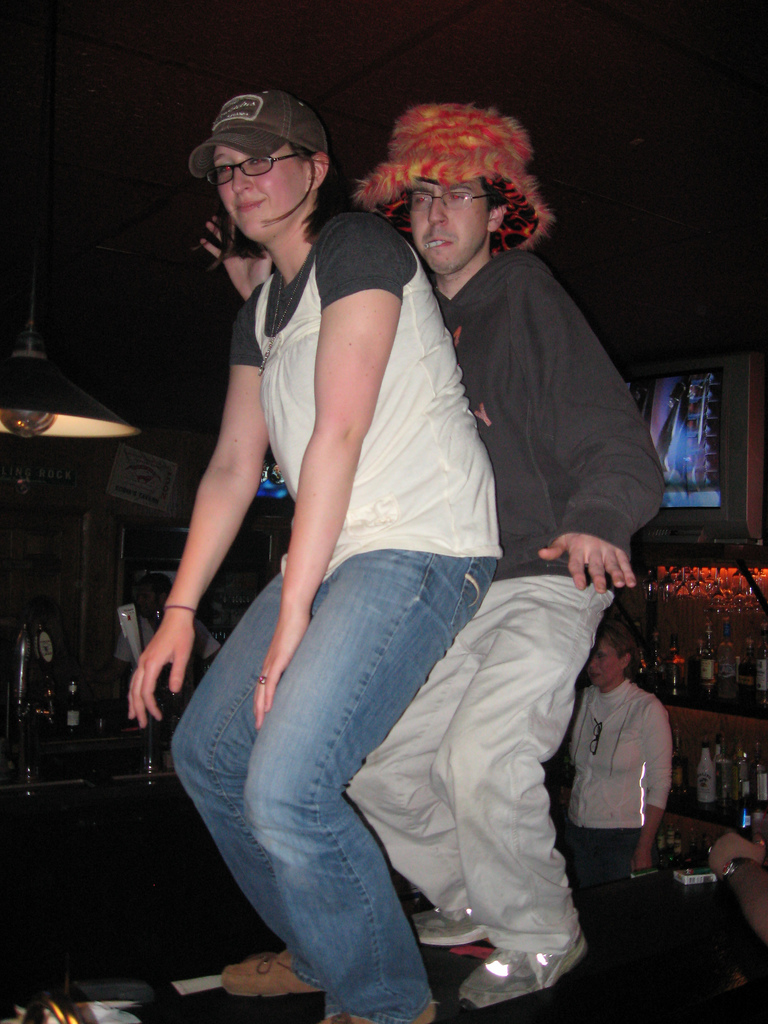
Grinding
An intimate partner dance where dancers rub and bump their bodies together
Grinding is an intimate partner dance where dancers rub or bump their bodies together in close contact. Originating in burlesque and later popularized through hip hop club culture, it is commonly seen at nightclubs, parties, and school dances across North America.
Watch it dancedShare on WhatsApp
- Roots date back over a century to burlesque bump and grind striptease acts
- Gained wide popularity as a hip hop club dance before spreading to school proms
- Known as wining in the Anglophone Caribbean and juking or freaking elsewhere
- Caused controversy at North American high schools, leading to attempted bans
What is Grinding?
Grinding is a close, intimate partner dance. During the dance, two or more participants press, bump, and rub their bodies against one another. It usually features a woman moving her hips and buttocks repeatedly against a man's groin to create physical friction. The male partner commonly rests his hands upon the woman's waist, hips, or buttocks. It is known under several different names depending on the setting and region, including juking, freak dancing, or freaking. In parts of the Anglophone Caribbean, dancers refer to related movements as wining.
Where does Grinding come from?
Early versions of this physical style appeared more than a century ago in theatrical striptease routines known as the bump and grind, performed by burlesque entertainers. Decades later, the movement shifted into wider social spaces as a hip hop nightclub style. Over time, it spread beyond adult venues into youth culture, becoming a common sight at school parties and prom nights in both Canada and the United States.
How is Grinding danced?
Dancers maintain direct physical contact throughout the dance. One partner, typically female, stands in front and presses her rear against the groin of the partner behind her, creating continuous friction through rhythmic rubbing and bumping. The partner behind generally holds the front dancer by the waist, hips, or rear to stay connected. While usually shared between two people, groups of three or more may also join together. More extreme variations, such as daggering, involve forceful collisions between partners.
Grinding, drawn
When and where Grinding is danced
Grinding takes place primarily in recreational nightlife and casual celebration settings. It is commonly danced in commercial night clubs, music venues, and private parties. Over recent decades, it has also become a regular fixture at high school dances and graduation proms throughout North America, where students gather on crowded dance floors.
Styles of Grinding
The style carries different names and regional forms across various communities. It is called juking, freaking, or freak dancing in some areas, while dancers in the Anglophone Caribbean know similar waist-centered movements as wining. An energetic and graphic variant known as daggering features a male dancer forcefully slamming his pelvis into the rear of his female partner.
What Grinding means
Because of its overtly intimate physical contact, grinding has sparked significant public debate. Its widespread popularity at teenage social functions, especially high school proms and dances across the United States and Canada, has provoked controversy among administrators and led directly to attempted bans at student gatherings. Critics object to the sexual friction involved in the movements.
Questions people ask about Grinding
Where does grinding come from?
Early forms appeared over a century ago in burlesque striptease routines as the bump and grind. It later spread into wider culture through hip hop night clubs before entering school dance scenes.
When and where is grinding danced?
Grinding is danced in social nightlife venues, night clubs, and private parties. It is also frequently danced by teenagers and students at high school dances and proms across North America.
What are other names for grinding?
It is also known as juking, freaking, or freak dancing. In the Anglophone Caribbean it is called wining, while a more aggressive variation is known as daggering.
Why has grinding faced controversy?
The dance involves intimate friction between dancers' bodies and pelvic areas. Its popularity among teenagers at school dances and proms in Canada and the United States led to controversy and attempted bans.
Good reading and sources
- Grinding (dance) on WikipediaEncyclopedia
- Wikidata recordOpen data
- Videos of Grinding on YouTubeSearch results, not chosen by Ghungroo
The facts on this page come from the Wikipedia article "Grinding (dance)", written by its contributors and used under the CC BY-SA 4.0 licence, and from its Wikidata record (CC0). Ghungroo rewrote the text in its own words, with AI assistance, and compares every page with the article to make sure no passage is copied. It may be reused under the same CC BY-SA 4.0 licence with a link back.
It may contain mistakes, and it describes the dance in outline: it is not a lesson. Traditions differ from one teacher, village or family to the next. If something is wrong, tell us. Last refreshed 2026-10-04.
More from the United States
All the dances of the United States 🇺🇸 United States and 5 moreBreakdancing
A street dance with acrobatics, floorwork and freezes, born in 1970s New York CityStreet or club dance · Solo · Group
🇺🇸 United States and 5 moreBreakdancing
A street dance with acrobatics, floorwork and freezes, born in 1970s New York CityStreet or club dance · Solo · Group
 🇵🇱 Poland and 3 morePolonaisePolonez, chodzony
A stately walking dance in triple time, opening Polish celebrations and ballsFolk dance · Couple · Procession
🇵🇱 Poland and 3 morePolonaisePolonez, chodzony
A stately walking dance in triple time, opening Polish celebrations and ballsFolk dance · Couple · Procession
 🇨🇺 Cuba and 2 moreSalsa
A lively partner dance with spins and footwork, danced to salsa music worldwideSocial dance · Couple · Solo
🇨🇺 Cuba and 2 moreSalsa
A lively partner dance with spins and footwork, danced to salsa music worldwideSocial dance · Couple · Solo
 🇬🇧 United Kingdom and 5 moreBallroom dance
Partner dances performed socially and in competition, with roots in EuropeSocial dance · Couple · Group
🇬🇧 United Kingdom and 5 moreBallroom dance
Partner dances performed socially and in competition, with roots in EuropeSocial dance · Couple · Group
Its cousins elsewhere
All social dances 🇦🇷 Argentina and 1 moreTango
A partner dance from the Río de la Plata, danced in close or open embraceSocial dance · Couple
🇦🇷 Argentina and 1 moreTango
A partner dance from the Río de la Plata, danced in close or open embraceSocial dance · Couple
 🇮🇳 India and 1 moreFolk dance
Traditional group dances rooted in local life and passed down through generationsFolk dance · Group · Circle
🇮🇳 India and 1 moreFolk dance
Traditional group dances rooted in local life and passed down through generationsFolk dance · Group · Circle
 🇪🇬 Egypt and 3 moreBelly danceرقص شرقي
A Middle Eastern dance focused on hip and torso articulation.Folk dance · Solo
🇪🇬 Egypt and 3 moreBelly danceرقص شرقي
A Middle Eastern dance focused on hip and torso articulation.Folk dance · Solo
 🇸🇪 SwedenSmå grodorna
A playful Swedish dance around the maypole for Midsummer, miming frog movementsFolk dance · Circle · Group
🇸🇪 SwedenSmå grodorna
A playful Swedish dance around the maypole for Midsummer, miming frog movementsFolk dance · Circle · Group