
Hornpipe
A solo or couple dance with lively steps, found in Britain and Ireland since the 16th century
Hornpipe refers to a group of dances and tunes from Great Britain and Ireland, performed solo or in couples. It is known for energetic footwork, folded arms in solo versions, and is still danced in competitions today, especially in Ireland and England. The dance has both stage and social forms and is closely linked to characteristic hornpipe music.
Watch it dancedShare on WhatsApp
- Hornpipe has been danced in Britain and Ireland since the 16th century
- The sailor's hornpipe mimics life aboard ship and is linked to the Royal Navy
- Hornpipe music shifted from triple time to 4/4 by the 19th century
- In Irish competition, hornpipe is danced in hard shoes at a set minimum tempo
- Solo hornpipes often feature folded arms and complex footwork
What is Hornpipe?
Hornpipe is a dance style from Britain and Ireland, known for its lively steps and distinctive music. It can be performed solo, often with folded arms, or by couples who dance a series of steps and turns. The dance is seen both on stage and in social settings, and is a staple in competitions, especially in Ireland. Its music and movement are closely linked, with the dance often used to show off agility and precise footwork.
Where does Hornpipe come from?
The hornpipe has roots in Britain and Ireland, with references dating back to the 16th century. Its name may come from a wind instrument, though this is debated. The dance appears in English literature and was a feature of theater interludes. By the 18th century, it was taught by dancing masters and became part of the entertainer's skill set. Sailors adopted the hornpipe as exercise and pastime, and it became associated with maritime life, especially in the Royal Navy.
How is Hornpipe danced?
Solo hornpipes are marked by energetic, intricate footwork and a calm upper body, often with arms folded to show control. In couple or group forms, dancers perform steps and turns in varied combinations, sometimes swinging partners by the hand. The dance can be a display of strength and agility, with some versions emphasizing rapid, complex steps. In competitions, hard shoes are worn to make the steps audible.
Hornpipe, drawn
The music of Hornpipe
Hornpipe music has evolved from triple time (such as 3/2, 6/2, 9/4, 9/8) to common time (4/4) by the 19th century. Tunes often feature repeated sections for variation. Famous hornpipe melodies include 'The Sailor's Hornpipe', 'The College Hornpipe', and works by composers like Handel and Purcell. The rhythm can be even or dotted, and the music is central to the dance's character.
Costume and what is carried
Costume varies by context. In the 'sailor's hornpipe', performers dress as sailors, sometimes mimicking shipboard life. In competitions, dancers wear hard shoes to make their steps heard. Historical references do not specify a set costume for social or couple hornpipes.
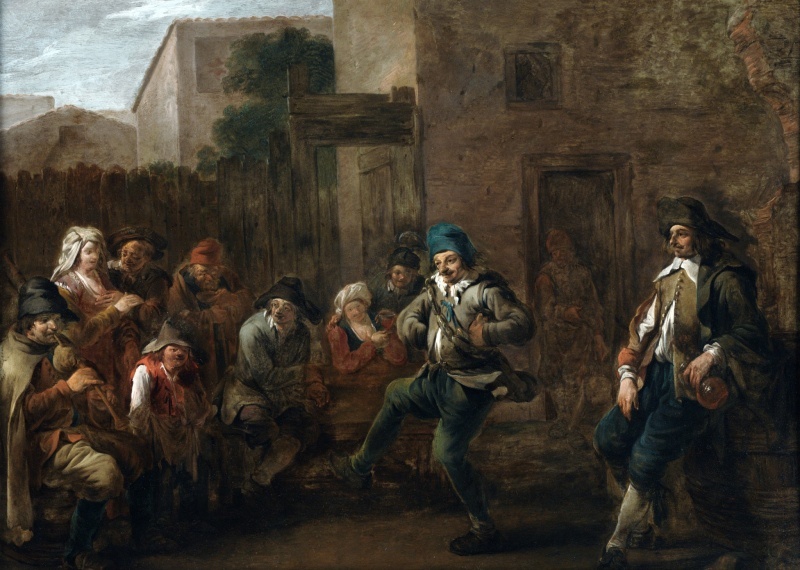


When and where Hornpipe is danced
Hornpipes are danced at festivals, balls, competitions, and on stage. In Ireland, it is a staple of dance competitions, often performed by men. Sailors danced hornpipes aboard ships for exercise and entertainment. The dance has been passed down through manuals, teachers, and tradition.
Styles of Hornpipe
There are many forms of hornpipe, including solo step dances, couple dances, and the sailor's hornpipe. Regional styles differ, with some focusing on triple-time rhythms and others on 4/4. Tunes and steps are often named after dancers or places. The Newcastle Style blends even and dotted rhythms.
What Hornpipe means
Hornpipe is a symbol of English and Irish dance tradition, with strong ties to maritime culture through the sailor's hornpipe. It has appeared in literature, theater, and classical music. The dance remains part of folk and competitive dance scenes, reflecting both local identity and broader cultural history.
Questions people ask about Hornpipe
Where does the hornpipe come from?
Hornpipe dances originated in Great Britain and Ireland, with references from the 16th century onward. It has strong associations with regions like Lancashire, Nottingham, and Wales.
When is the hornpipe danced?
Hornpipes are performed at festivals, balls, competitions, and stage shows. Sailors also danced it aboard ships for exercise and entertainment.
Who usually dances the hornpipe?
The dance can be performed solo, in couples, or in groups. In Irish competitions, it is traditionally danced by men, but other forms are open to all.
What music is used for the hornpipe?
Hornpipe tunes were originally in triple time but shifted to 4/4 by the 19th century. Famous hornpipe melodies include 'The Sailor's Hornpipe' and works by Handel and Purcell.
What makes the hornpipe dance unique?
Solo hornpipes are known for folded arms and energetic, complex footwork, while the sailor's hornpipe mimics shipboard tasks. The dance is closely tied to its distinctive music.
Good reading and sources
- Encyclopaedia BritannicaArticle
- The Treasures of Terpsichore by T. Wilson (1809)English Folk Dance and Song Society, Article
- Hornpipe on WikipediaEncyclopedia
- More photos and video on Wikimedia CommonsPhotos and video
- Wikidata recordOpen data
- Videos of Hornpipe on YouTubeSearch results, not chosen by Ghungroo
The facts on this page come from the Wikipedia article "Hornpipe", written by its contributors and used under the CC BY-SA 4.0 licence, and from its Wikidata record (CC0). Ghungroo rewrote the text in its own words, with AI assistance, and compares every page with the article to make sure no passage is copied. It may be reused under the same CC BY-SA 4.0 licence with a link back.
It may contain mistakes, and it describes the dance in outline: it is not a lesson. Traditions differ from one teacher, village or family to the next. If something is wrong, tell us. Last refreshed 2026-10-03.
More from the United Kingdom
All the dances of the United Kingdom 🇮🇳 India and 1 moreGarba
A circle dance from Gujarat performed around a clay pot during the Navratri festival.Folk dance · Circle
🇮🇳 India and 1 moreGarba
A circle dance from Gujarat performed around a clay pot during the Navratri festival.Folk dance · Circle
 🇧🇪 Belgium and 5 moreProcessional giant
Huge costumed figures carried and danced in European street processionsFolk dance · Solo · Procession
🇧🇪 Belgium and 5 moreProcessional giant
Huge costumed figures carried and danced in European street processionsFolk dance · Solo · Procession
 🇬🇧 United Kingdom and 5 moreBallroom dance
Partner dances performed socially and in competition, with roots in EuropeSocial dance · Couple · Group
🇬🇧 United Kingdom and 5 moreBallroom dance
Partner dances performed socially and in competition, with roots in EuropeSocial dance · Couple · Group
 🇺🇸 United States and 1 moreJive
A lively partner dance from 1930s African American communities in the USSocial dance · Couple
🇺🇸 United States and 1 moreJive
A lively partner dance from 1930s African American communities in the USSocial dance · Couple
Its cousins elsewhere
All folk dances 🇦🇷 Argentina and 1 moreTango
A partner dance from the Río de la Plata, danced in close or open embraceSocial dance · Couple
🇦🇷 Argentina and 1 moreTango
A partner dance from the Río de la Plata, danced in close or open embraceSocial dance · Couple
 🇮🇳 India and 1 moreFolk dance
Traditional group dances rooted in local life and passed down through generationsFolk dance · Group · Circle
🇮🇳 India and 1 moreFolk dance
Traditional group dances rooted in local life and passed down through generationsFolk dance · Group · Circle
 🇧🇷 BrazilCapoeira
A Brazilian martial art that blends dance, acrobatics, and music in a circle gameWar or martial dance · Circle · Solo
🇧🇷 BrazilCapoeira
A Brazilian martial art that blends dance, acrobatics, and music in a circle gameWar or martial dance · Circle · Solo
 🇪🇬 Egypt and 3 moreBelly danceرقص شرقي
A Middle Eastern dance focused on hip and torso articulation.Folk dance · Solo
🇪🇬 Egypt and 3 moreBelly danceرقص شرقي
A Middle Eastern dance focused on hip and torso articulation.Folk dance · Solo