
Kuda Lumping
In its own language: ꦗꦫꦤ꧀ꦏꦺꦥꦁ
A Javanese ritual dance riding flat woven horses into states of trance
Kuda Lumping is a traditional Javanese dance from Indonesia in which performers ride flat horses made of woven bamboo or rattan. Groups enact cavalry drills and often enter trances, performing feats like walking on fiery coals or eating glass during community events and rites.
Watch it dancedShare on WhatsApp
- Dancers ride flat props made from woven bamboo or rattan.
- Performances often feature trance states where dancers eat glass or step on hot coals.
- Rooted in Java, the dance is also kept alive by diaspora groups in Suriname and Malaysia.
- The Jathilan variant in East Java is danced without trances or firewalking stunts.
What is Kuda Lumping?
Kuda Lumping is an Indonesian folk dance created on the island of Java. Performers straddle flat, decorated horse figures woven from bamboo strips or rattan to mimic horse soldiers in motion. The presentation typically features an ensemble of two to eight dancers moving to gongs and bamboo rattles. During standard routines, troupes simulate equestrian maneuvers, but many events culminate in deep trance states. Under spirit possession, dancers display extraordinary physical feats, guided and supervised by a whip-bearing handler. They might chew shards of glass, step across glowing embers, or mimic horse behavior by eating grass and lapping water. Spectators observe from outside a designated ring where the troupe interacts with them.
Where does Kuda Lumping come from?
The tradition originated on Java, with strong roots traced to Ponorogo in East Java. Historians and local lore propose two main historical explanations for its development. One perspective views the dance as a ritual recreation of Prince Diponegoro's nineteenth-century armed struggle against Dutch colonial rule. Another hypothesis suggests it represents cavalry units from the Mataram kingdom fighting foreign colonizers. Regional names evolved across the Indonesian archipelago. While known as Kuda Lumping in West Java, people in Central Java call it Jaran Kepang, East Javanese communities refer to it as Jathilan, and in Bali a related trance variant is termed Sang Hyang Jaran.
How is Kuda Lumping danced?
Performers dance in an enclosed space while gripping imitation mounts between their legs. The initial choreography involves coordinated formation drills that replicate military cavalry routines. As the rhythm intensifies, dancers may transition into trance, shifting from disciplined patterns to erratic, energetic motions. Guided by a handler wielding a whip, possessed participants act out animal mannerisms, kneeling to consume forage or drink. Some dancers perform daring physical demonstrations such as swallowing flames or walking bare on burning embers. In certain regional traditions, performers step forward during altered states to share prophetic messages before regaining normal consciousness without recalling their actions.
Kuda Lumping, drawn
The music of Kuda Lumping
The dance is propelled by rhythmic Javanese musical instruments. Accompaniment centers on interlocking gamelan tones, resonant gongs, tuned bamboo angklung rattles, and barrel drums known as kendhang or dog-dog drums. The auditory pace directs the transitions from structured cavalry marching into the climactic trance phase. In the Balinese Sang Hyang Jaran style, spectators also form a seated vocal chorus to sing alongside the percussion.
Costume and what is carried
Dancers wear bright garments, sometimes styled after historic warrior uniforms, accented with small jingling bells fastened at the ankles. Performers carry flat toy steeds fashioned from woven cane or sliced bamboo mats, embellished with vivid paints, shiny spangles, and strands of beads. Grown dancers handle full-sized horse props, whereas younger participants handle smaller versions. The vibrant, ornamental styling of the dancers stands in contrast to the plainer, commanding presence of the attending shaman.
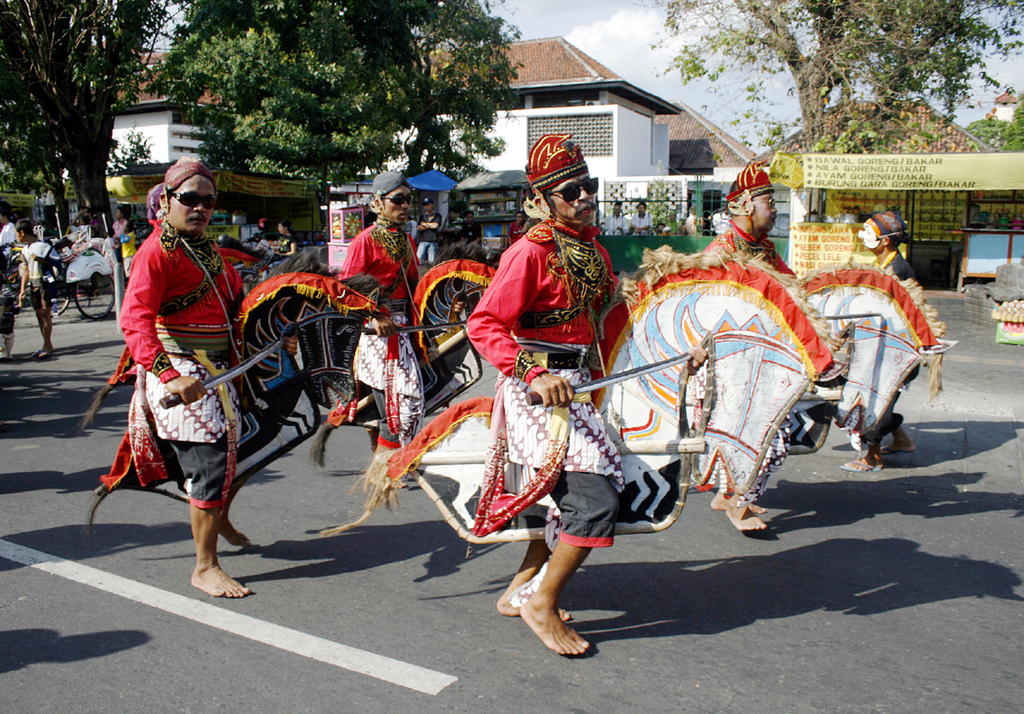


When and where Kuda Lumping is danced
Performances take place during community celebrations and family milestones, particularly boys' circumcision rites. Troupes also stage busking shows in public squares, collecting cash contributions from bystanders. The dance is held within a cordoned area that keeps the gathering crowd safe from erratic movements during trance demonstrations. Beyond Java, migrant diaspora communities preserve the tradition in Singapore, Malaysia, and Suriname.
Styles of Kuda Lumping
Regional styles exhibit noticeable differences in theme and staging. In East Java, the Jathilan form appears as a segment within Reog Ponorogo pageantry. Unlike standard Jaran Kepang, Jathilan presents refined, attractive riders who historically were played by young men called gemblakan and are now commonly performed by women. This East Javanese style excludes trance states, glass consumption, and firewalking. In Bali, Sang Hyang Jaran functions as a sacred spirit-possession rite accompanied by communal singing.
What Kuda Lumping means
Interpretations of Kuda Lumping vary between sacred ritual and secular folk theatre. While modern audiences often treat it as street entertainment, community members historically viewed trance manifestations as contact with spiritual forces. Its practice has stirred modern debate; for example, Malaysian Syariah authorities raised legal objections regarding non-Islamic worship practices in 2025, prompting religious officials to clarify that cultural heritage must align with Islamic beliefs. The dance has also entered popular culture through modern dangdut musical adaptations.
Questions people ask about Kuda Lumping
Where did Kuda Lumping originate?
Kuda Lumping originated on the island of Java in Indonesia, with strong associations to Ponorogo in East Java. It is also preserved by Javanese diaspora communities across Malaysia, Singapore, and Suriname.
When and why is Kuda Lumping performed?
It is staged for festive social gatherings, street entertainment, and major rites of passage, such as circumcisions for young boys. Some communities also perform it to seek prophecies through spirit trance.
What props and instruments are used in the dance?
Performers hold woven rattan or bamboo horses and wear ankle bells. Music is provided by traditional instruments including gamelan gongs, kendhang drums, and bamboo angklung rattles.
Do all styles of this horse dance include trances?
No. While many Javanese troupes incorporate spirit possession, glass eating, and coal walking, the East Javanese Jathilan style focuses strictly on choreography and does not include trance stunts.
Good reading and sources
- Kuda Lumping on WikipediaEncyclopedia
- Wikidata recordOpen data
- Videos of Kuda Lumping on YouTubeSearch results, not chosen by EveryGhunghroo
The facts on this page come from the Wikipedia article "Kuda Lumping", written by its contributors and used under the CC BY-SA 4.0 licence, and from its Wikidata record (CC0). EveryGhunghroo rewrote the text in its own words, with AI assistance, and compares every page with the article to make sure no passage is copied. It may be reused under the same CC BY-SA 4.0 licence with a link back.
It may contain mistakes, and it describes the dance in outline: it is not a lesson. Traditions differ from one teacher, village or family to the next. If something is wrong, tell us. Last refreshed 2026-10-04.
More from Indonesia
All the dances of Indonesia 🇨🇳 China and 5 moreLion dance舞獅
A costumed dance that mimics a lion to bring luck and drive away evilFolk dance · Group · Procession
🇨🇳 China and 5 moreLion dance舞獅
A costumed dance that mimics a lion to bring luck and drive away evilFolk dance · Group · Procession
 🇮🇩 IndonesiaLegongᬮᬾᬕᭀᬂ
A Balinese dance with intricate finger, foot and facial movementsFolk dance · Group
🇮🇩 IndonesiaLegongᬮᬾᬕᭀᬂ
A Balinese dance with intricate finger, foot and facial movementsFolk dance · Group
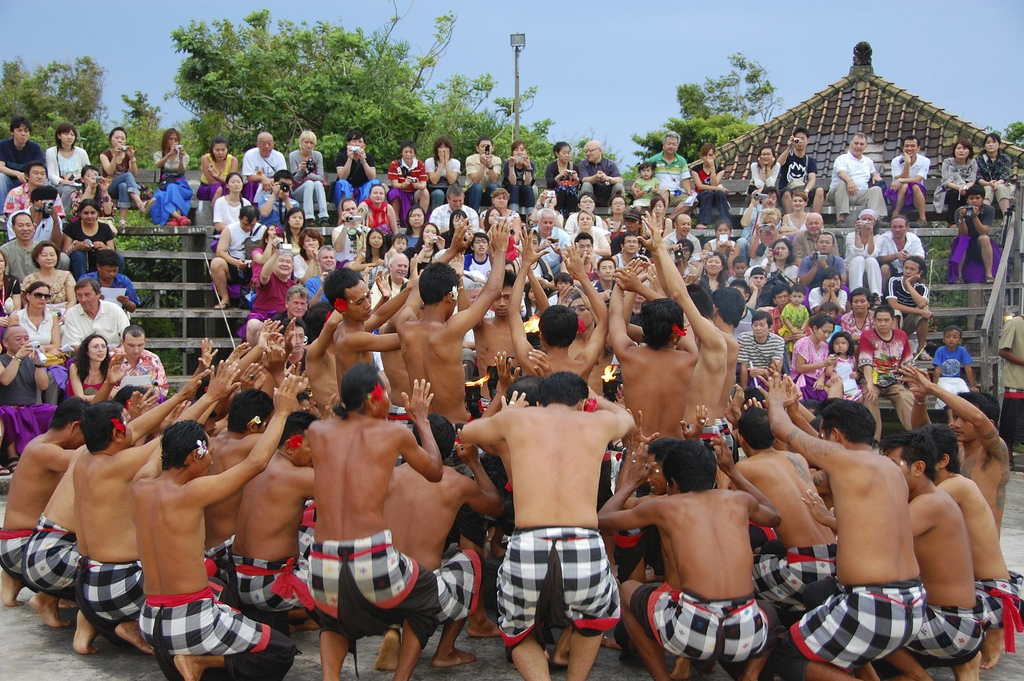 🇮🇩 IndonesiaKecakᬓᬾᬘᬓ᭄
A massed chant and dance-drama from Bali, performed in a circle at duskFolk dance · Circle · Group
🇮🇩 IndonesiaKecakᬓᬾᬘᬓ᭄
A massed chant and dance-drama from Bali, performed in a circle at duskFolk dance · Circle · Group
 🇮🇩 IndonesiaPendetᬧᭂᬦ᭄ᬤᭂᬢ᭄
A Balinese dance where girls offer flowers to greet guests and spiritsFolk dance · Group
🇮🇩 IndonesiaPendetᬧᭂᬦ᭄ᬤᭂᬢ᭄
A Balinese dance where girls offer flowers to greet guests and spiritsFolk dance · Group
Its cousins elsewhere
All folk dances 🇪🇸 Spain and 5 moreWeapon dance
A ceremonial reenactment of combat using swords, staffs, spears, and archery bowsWar or martial dance · Solo · Circle
🇪🇸 Spain and 5 moreWeapon dance
A ceremonial reenactment of combat using swords, staffs, spears, and archery bowsWar or martial dance · Solo · Circle
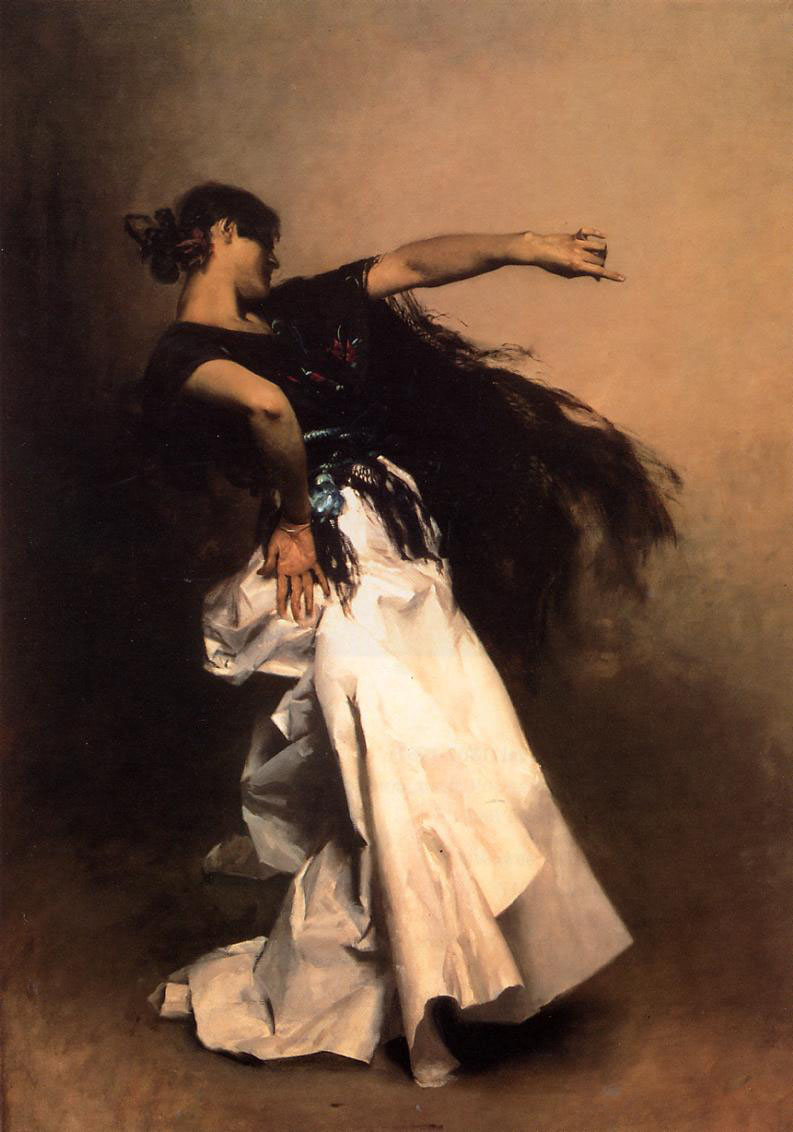 🇪🇸 SpainFlamenco
A southern Spanish art form of rhythmic footwork, singing, and acoustic guitarFolk dance · Solo · Group
🇪🇸 SpainFlamenco
A southern Spanish art form of rhythmic footwork, singing, and acoustic guitarFolk dance · Solo · Group
 🇦🇹 Austria and 5 moreWaltzWalzer
A gliding partner dance in triple time, performed in a turning closed embraceBallroom or Latin dance · Couple · Set or square
🇦🇹 Austria and 5 moreWaltzWalzer
A gliding partner dance in triple time, performed in a turning closed embraceBallroom or Latin dance · Couple · Set or square
 🇧🇷 BrazilCapoeira
A Brazilian martial art that blends dance, acrobatics, and music in a circle gameWar or martial dance · Circle · Solo
🇧🇷 BrazilCapoeira
A Brazilian martial art that blends dance, acrobatics, and music in a circle gameWar or martial dance · Circle · Solo