🇮🇩 The dances of Indonesia
16 dances from Indonesia, best known first, across 22 cities and regions.
Indonesia's dance is built from the traditions of more than 600 ethnic groups, so the country holds thousands of separate forms rather than one. Tribal ritual, Hindu-Buddhist court refinement, Islamic adaptation and later outside influence sit in layers, and both village and palace traditions are still practised and still being extended.
- Saman, a fast and tightly harmonised dance from Aceh, joined the UNESCO heritage list in 2011.
- Three genres of Balinese dance were recognised by UNESCO in December 2015.
- Indonesia has more than 600 ethnic groups and over 3,000 original dance forms.
- Bedhaya, a sacred dance of young Javanese women, may reach back to the Majapahit court.
- Poco-poco from Minahasa and Sajojo from Papua became mass dances many people do at once.
Dance in Indonesia
Indonesia has more than 600 ethnic groups, and dance is one of the clearest places that difference shows. Austronesian roots and Melanesian tribal forms are both visible, and traders, religions and colonisers added further layers over the centuries. Almost every community keeps its own repertoire. What these dances share is a close tie to place: they mark harvests, welcome guests, tell epics or honour spirits. Scholars sort them by era (tribal, Hindu-Buddhist, Islamic), by patron (court or folk) and by tradition (traditional or contemporary). Courtly forms prize refinement and restraint; village forms stay looser and invite everyone in.
Classical, court and temple dance
Java and Bali hold the oldest court and temple styles. Javanese court dance is slow and restrained, with a stillness and control that carries meaning. Bedhaya, a sacred Javanese dance for young women, is gentle and elegant and was offered to Indic deities; it seems to reach back to the Majapahit court or earlier. Wayang wong dance-drama draws its plots from the Ramayana and Mahabharata. Bali's court and temple dances are livelier and more expressive, and friezes on East Javanese temples from the 14th century show headdresses that dancers in Bali still wear. Topeng mask dances, found in both Java and Bali, tell Panji stories.
Folk and regional dances 13 dances
Folk dances belong to ordinary people, in villages and cities, and were shaped without palace help. They sit closer to entertainment and social life than to ritual, and they carry fewer fixed rules, though gestures and postures still follow local custom. Ronggeng in Java and Jaipongan in Sunda are the best known: social dances made for pleasure, whose freer movement once struck court observers as immodest. Some folk dances grew into mass dances with simple steps, which is how Poco-poco from Minahasa in North Sulawesi and Sajojo from Papua came to be done by many people at once.
Ritual and ceremonial dance 11 dances
Many scholars trace Indonesian dance back to worship. Tribal communities kept dances for war, healing, rain and harvest. Hudoq, danced by Dayak people, belongs to agricultural ritual; cakalele from Maluku and kabasaran from Minahasa are war dances. Some are repetitive by design, like the Batak Tor-Tor, which lets an inner spirit come out or settles the spirits around. Trance belongs to several traditions: the young girls of Sanghyang Dedari in Bali are said to be entered by spirits as they drive away bad ones, and trance also appears in kuda lumping and keris dances, in Barong, and in sacred Balinese temple rites.
Ballet and contemporary dance
Contemporary dance in Indonesia takes cues from abroad while staying tied to local traditions. Bagong Kussudiardja is the best-known figure, having built a contemporary form out of Javanese classical movement. Alongside this, the art institutes, STSI in Bandung, IKJ in Jakarta and ISI in Denpasar, Yogyakarta and Surakarta, train students in the traditional repertoire and encourage them to push it further. The result is kreasi baru, newly made dances that keep within a tradition's rules. Sendratari dance-dramas, like the Ramayana ballet staged at Prambanan temple, work in a similar way, and the Bali Art Festival gives choreographers room to show new work.
Music and dress
Gamelan, the tuned percussion orchestra of bronze gongs, keys and drums, accompanies most Javanese and Balinese dance, and the music is written to fit the movement. In the Islamic era, Arab and Persian instruments arrived, and rebana frame drums, tambur and gendang became standard for dances like Zapin and Saman, often with sung verse that quotes Islamic chant. Costume signals a great deal. Court and ritual dress carries gold ornament and elaborate headdress, much of it resembling the headgear carved on 14th-century Javanese temples; dances shaped after Islam cover the body more fully while keeping that older gold.
From region to region
Every ethnic group carries its own dance, and the differences between them are regional as much as anything else. Java and Bali share a Hindu-Buddhist inheritance and the same epic stories, but Java's courts go for slowness and restraint while Bali's go for energy and expression. Malay and Acehnese areas, along with courts in Sumatra such as Deli and Palembang, show more Islamic influence; Gending Sriwijaya from Palembang keeps gilded Hindu-Buddhist ornament yet wears a more covered costume. In the interior, Batak, Nias, Mentawai, Dayak, Baduy, Toraja, Minahasa, Moluccan and Papuan communities hold on to tribal forms, from the Tor-Tor of North Sumatra to the war dances of Minahasa and Maluku.
Dance today
Two dance traditions hold UNESCO Intangible Cultural Heritage status. Saman from Aceh was added in 2011, noted for its fast movement and the tight harmony between its dancers. Three genres of Balinese dance followed in 2015. Teaching is steady: government-run art academies and palace schools such as Mangkunegaran's Suryo Sumirat in Surakarta both train dancers and open classes to outsiders. Dance keeps being made and remade, with kreasi baru offered as new work inside old frames, and festivals like the Bali Art Festival giving that work a stage.
The facts in this overview come from the Wikipedia article "Dance in Indonesia", written by its contributors and used under the CC BY-SA 4.0 licence. Ghungroo rewrote the text in its own words, with AI assistance, and compares every page with the article to make sure no passage is copied. It may be reused under the same CC BY-SA 4.0 licence with a link back.
 🇨🇳 China and 5 moreLion dance舞獅
A costumed dance that mimics a lion to bring luck and drive away evilFolk dance · Group · Procession
🇨🇳 China and 5 moreLion dance舞獅
A costumed dance that mimics a lion to bring luck and drive away evilFolk dance · Group · Procession
 🇮🇩 IndonesiaLegongᬮᬾᬕᭀᬂ
A Balinese dance with intricate finger, foot and facial movementsFolk dance · Group
🇮🇩 IndonesiaLegongᬮᬾᬕᭀᬂ
A Balinese dance with intricate finger, foot and facial movementsFolk dance · Group
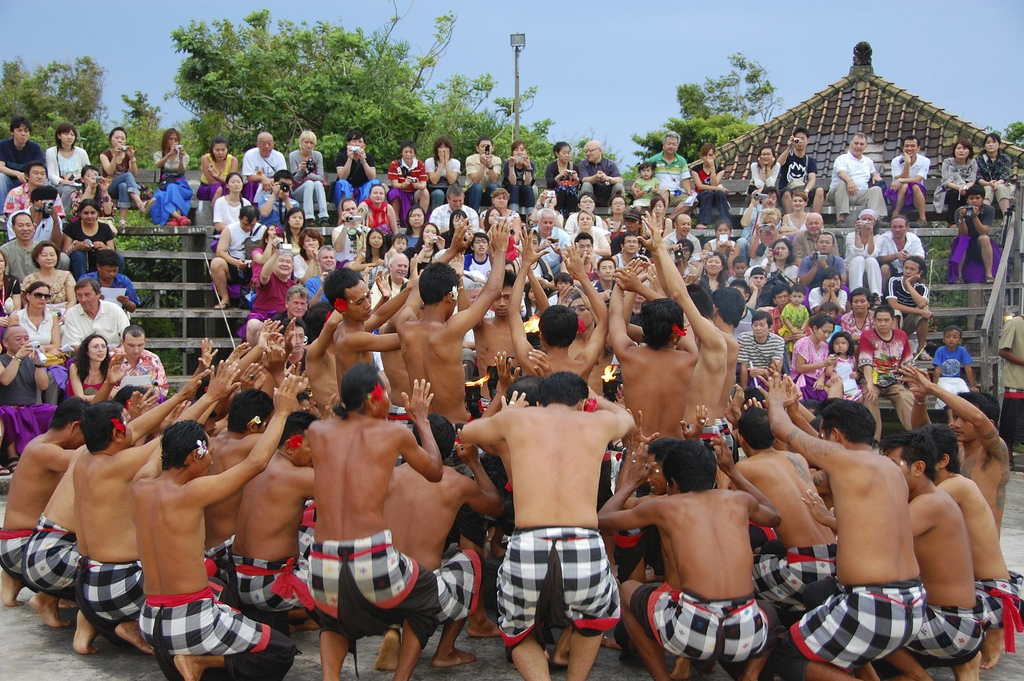 🇮🇩 IndonesiaKecakᬓᬾᬘᬓ᭄
A massed chant and dance-drama from Bali, performed in a circle at duskFolk dance · Circle · Group
🇮🇩 IndonesiaKecakᬓᬾᬘᬓ᭄
A massed chant and dance-drama from Bali, performed in a circle at duskFolk dance · Circle · Group
 🇮🇩 IndonesiaPendetᬧᭂᬦ᭄ᬤᭂᬢ᭄
A Balinese dance where girls offer flowers to greet guests and spiritsFolk dance · Group
🇮🇩 IndonesiaPendetᬧᭂᬦ᭄ᬤᭂᬢ᭄
A Balinese dance where girls offer flowers to greet guests and spiritsFolk dance · Group
 🇨🇳 China and 6 morePeacock dance
A folk dance imitating the peacock, found across South and Southeast AsiaFolk dance · Solo · Group
🇨🇳 China and 6 morePeacock dance
A folk dance imitating the peacock, found across South and Southeast AsiaFolk dance · Solo · Group
 🇮🇩 IndonesiaBarisᬩᬭᬶᬲ᭄, igélan baris
A Balinese dance that honors the spirit and stance of a warriorFolk dance · Solo · Group
🇮🇩 IndonesiaBarisᬩᬭᬶᬲ᭄, igélan baris
A Balinese dance that honors the spirit and stance of a warriorFolk dance · Solo · Group
 🇮🇩 IndonesiaWar dance
A ritual or ceremonial dance that imitates combat or battleWar or martial dance · Group · Solo
🇮🇩 IndonesiaWar dance
A ritual or ceremonial dance that imitates combat or battleWar or martial dance · Group · Solo
 🇾🇪 Yemen and 4 moreZapinزافين
A Malay partner dance with Arab roots, performed to the strum of a lute and the beat of drums.Folk dance · Couple
🇾🇪 Yemen and 4 moreZapinزافين
A Malay partner dance with Arab roots, performed to the strum of a lute and the beat of drums.Folk dance · Couple
 🇮🇩 IndonesiaBarong danceᬩᬅᬭᬑᬂ
A Balinese dance-drama of Barong and Rangda, showing the struggle of good and evilFolk dance · Group · Procession
🇮🇩 IndonesiaBarong danceᬩᬅᬭᬑᬂ
A Balinese dance-drama of Barong and Rangda, showing the struggle of good and evilFolk dance · Group · Procession
 🇮🇩 IndonesiaRejang danceᬋᬚᬂ
A sacred Balinese dance offering performed by girls at temple ceremoniesRitual dance · Procession · Group
🇮🇩 IndonesiaRejang danceᬋᬚᬂ
A sacred Balinese dance offering performed by girls at temple ceremoniesRitual dance · Procession · Group
 🇲🇾 Malaysia and 2 moreNgajatTanda Ngajat
A traditional Iban dance from Sarawak mimicking birds and warriors through rhythmic jumping.Folk dance · Circle · Group
🇲🇾 Malaysia and 2 moreJogetTarian Joget
A couple's folk dance from Malacca with Portuguese roots and quick duple beats.Folk dance · Couple · Group
🇲🇾 Malaysia and 2 moreNgajatTanda Ngajat
A traditional Iban dance from Sarawak mimicking birds and warriors through rhythmic jumping.Folk dance · Circle · Group
🇲🇾 Malaysia and 2 moreJogetTarian Joget
A couple's folk dance from Malacca with Portuguese roots and quick duple beats.Folk dance · Couple · Group
 🇮🇩 IndonesiaBalinese dancetarian Bali / igélan Bali
A dynamic and angular dance tradition from the Indonesian island of Bali.Ritual dance · Group · Solo
🇮🇩 IndonesiaBalinese dancetarian Bali / igélan Bali
A dynamic and angular dance tradition from the Indonesian island of Bali.Ritual dance · Group · Solo
 🇮🇩 IndonesiaPiring danceTari Piring
A Minangkabau plate dance from West Sumatra where dancers balance spinning ceramics on their palms.Folk dance · Group · Couple
🇮🇩 IndonesiaPiring danceTari Piring
A Minangkabau plate dance from West Sumatra where dancers balance spinning ceramics on their palms.Folk dance · Group · Couple
 🇮🇩 IndonesiaTopeng danceTari Topeng
A masked Indonesian dance-drama telling ancient stories through movement and gamelan musicDance-drama · Solo · Group
🇮🇩 IndonesiaTopeng danceTari Topeng
A masked Indonesian dance-drama telling ancient stories through movement and gamelan musicDance-drama · Solo · Group
 🇮🇩 Indonesia and 1 moreReogꦫꦺꦪꦺꦴꦒ꧀
A Javanese dance drama featuring a massive lion mask carried by the teeth of a strongman.Folk dance · Group
🇮🇩 Indonesia and 1 moreReogꦫꦺꦪꦺꦴꦒ꧀
A Javanese dance drama featuring a massive lion mask carried by the teeth of a strongman.Folk dance · Group
Photo credits on this page
The small pictures above come from Wikimedia Commons under free licences. Some are cropped to fit.
- Zapin: Airiz, CC BY-SA 2.0, source
- Balinese dance: Crisco 1492, CC BY-SA 4.0, source
- Piring dance: Syofiardi Bachyul Jb, CC BY-SA 4.0, source
- Topeng dance: Sudanto Ponco Sularso, CC BY-SA 4.0, source
- Kecak: Rollan Budi, CC BY-SA 2.0, source
- Reog: Dedesudiana265, CC BY-SA 4.0, source
- War dance: Gunawan Kartapranata, CC BY-SA 3.0, source
- Lion dance: Alfresco24, CC BY 3.0, source
- Legong: P. (Paul) Spies (Fotograaf/photographer)., CC BY-SA 3.0, source
- Baris: Crisco 1492, CC BY-SA 4.0, source
- Pendet: Hendri Suhandi, CC BY-SA 4.0, source
- Peacock dance: Marcin Konsek, CC BY-SA 4.0, source
- Rejang dance: EGimaging, CC BY-SA 4.0, source
- Barong dance: Zsolt67 at Hungarian Wikipedia, Public domain, source
- Ngajat: Menuaibansarawak, CC0, source
Social and popular dance 3 dances
Social dancing here means dances made for people to enjoy together rather than for a rite or a stage. Ronggeng in Java and Jaipongan in Sunda are the clearest cases: they are public dances, and they value liveliness over courtly restraint. In Bali, joged serves as a social dance for young people. Folk styles later grew into mass dances with simple steps, which is how Poco-poco and Sajojo came to be done by many people at once. The line between folk and social dance is thin, since much of the folk repertoire exists for the same reasons.