
Pungmul
In its own language: 풍물
A Korean folk performance with drumming, dance, and song, rooted in farming life
Pungmul is a Korean folk tradition that blends drumming, dancing, and singing, usually performed outdoors by groups in constant motion. Originating from rural farming communities, it has been part of village events, rituals, and festivals, and today is seen both as a performance art and a symbol of Korean identity.
Watch it dancedShare on WhatsApp
- Pungmul blends drumming, dance, and singing in outdoor group performances.
- It is rooted in Korean farming and village life.
- Main instruments are kkwaenggwari, janggu, buk, jing, and sogo.
- Performers often wear hats with spinning ribbons (sangmo).
- Listed as UNESCO intangible cultural heritage in Korea and China.
What is Pungmul?
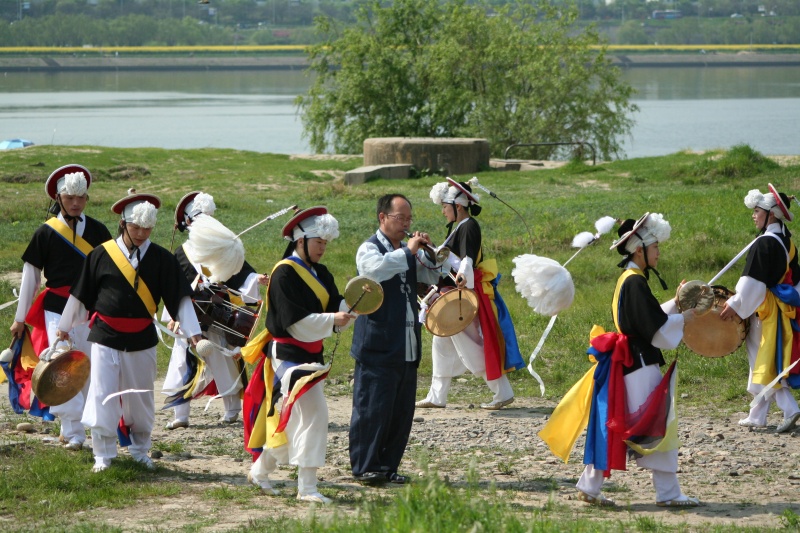
Pungmul is a lively Korean folk tradition where drumming, dance, and song come together in outdoor group performances. Dancers and musicians move continuously, often forming changing patterns or processions. The main instruments are gongs and drums, with occasional wind instruments and singing. Performers wear colorful costumes and, in some cases, hats with long ribbons that are spun and flipped through movement. The performance often blurs the line between audience and participants, inviting communal involvement.
Where does Pungmul come from?
Pungmul has its roots in Korea’s farming culture, where it was played during collective labor, village holidays, and shamanistic rituals. The term 'nongak', meaning 'farmers' music', became common during the Japanese colonial period, but many now prefer 'pungmul' to reflect its broader role. In the 20th century, pungmul was recognized as an Important Intangible Cultural Property in South Korea, and it has been listed by UNESCO as intangible heritage in both China and Korea. It has also served as a symbol in political protest and community gatherings.
How is Pungmul danced?
Pungmul combines group dances, solo displays, and skits. Dancers use both upper body and footwork, sometimes spinning hats with ribbons or playing small hand drums. The group forms various shapes and lines, and soloists may step forward for featured moments. Some performers act out village characters, adding humor and storytelling. Movement is energetic and often acrobatic, especially among those with ribboned hats or sogo drums.
Pungmul, drawn
The music of Pungmul
Drumming is central to pungmul, led by a small handheld gong (kkwaenggwari), with hourglass drums (janggu), barrel drums (buk), and large gongs (jing). Small hand drums (sogo) are often used by dancers. Wind instruments like the taepyeongso sometimes join in. Songs and chants, often in call-and-response, are set to recurring rhythmic patterns shared with other Korean genres. The music is lively, with shifting rhythms and tempos.
Costume and what is carried
Performers wear bright costumes, often with a flowery Buddhist-style headpiece (gokkal). Advanced troupes may use sangmo hats, which have long ribbons spun by head movements. Dancers with sogo drums may perform more elaborate choreography. Some members dress as village characters or caricatures, sometimes wearing masks, to interact with the audience. The overall look is festive and theatrical.


When and where Pungmul is danced
Pungmul is performed at festivals, village events, and rituals, as well as in staged concerts. It is also part of shamanistic ceremonies and mask dance dramas. In the past, it accompanied farm work and community gatherings. Today, it is taught and performed in Korea and abroad, including by Korean American groups. Audience participation is common, with singing and dancing along.
Styles of Pungmul
There are several regional styles, each with its own rhythms, costumes, and performance approach. Notable styles include Jinju Samcheonpo, Pyeongtaek, Iri, Gangneung, and Imsil Pilbong, each named for its home region. The Honam region is especially known for two contrasting styles: one with rapid, varied formations and another with slower, graceful rhythms. Modern forms like samul nori have adapted pungmul for stage performance.
What Pungmul means
Pungmul is seen as a symbol of Korean identity and community. It has been used in political protest and social movements, especially in the 1970s and 1980s. Its recognition as intangible cultural heritage by UNESCO and the Korean government highlights its cultural value. Pungmul continues to connect people to their heritage, both in Korea and in diaspora communities.
Questions people ask about Pungmul
Where does pungmul come from?
Pungmul comes from Korea, where it developed in rural farming communities as part of collective labor, village festivals, and rituals.
When is pungmul performed?
It is performed at festivals, village gatherings, shamanistic rituals, and as a staged performance. In the past, it was also played during farm work and communal events.
What instruments are used in pungmul?
The main instruments are the kkwaenggwari (small gong), janggu (hourglass drum), buk (barrel drum), jing (large gong), and sogo (small hand drum). Sometimes wind instruments and singing are included.
Who dances pungmul?
Pungmul is danced by mixed groups of men and women, often in large ensembles, with both musicians and dancers taking part.
What makes pungmul unique?
Pungmul combines music, dance, and theatrical skits, often with audience participation. Performers wear colorful costumes and sometimes hats with spinning ribbons, creating a festive and communal atmosphere.
Good reading and sources
- Pungmul on WikipediaEncyclopedia
- More photos and video on Wikimedia CommonsPhotos and video
- Wikidata recordOpen data
- Videos of Pungmul on YouTubeSearch results, not chosen by Ghungroo
The facts on this page come from the Wikipedia article "Pungmul", written by its contributors and used under the CC BY-SA 4.0 licence, and from its Wikidata record (CC0). Ghungroo rewrote the text in its own words, with AI assistance, and compares every page with the article to make sure no passage is copied. It may be reused under the same CC BY-SA 4.0 licence with a link back.
It may contain mistakes, and it describes the dance in outline: it is not a lesson. Traditions differ from one teacher, village or family to the next. If something is wrong, tell us. Last refreshed 2026-10-03.
More from South Korea
All the dances of South Korea 🇰🇷 South Korea and 1 moreGanggangsullae강강술래
A Korean circle dance sung and danced by women under the full moonFolk dance · Circle · Line or chain
🇰🇷 South Korea and 1 moreGanggangsullae강강술래
A Korean circle dance sung and danced by women under the full moonFolk dance · Circle · Line or chain
 🇰🇷 South Korea and 1 moreTalchum탈춤
A Korean mask dance-drama mixing satire, ritual and storyFolk dance · Group · Circle
🇰🇷 South Korea and 1 moreTalchum탈춤
A Korean mask dance-drama mixing satire, ritual and storyFolk dance · Group · Circle
 🇰🇷 South KoreaBuchaechum부채춤
A group fan dance created in 1954, performed by women using large painted fans.Folk dance · Group
🇰🇷 South KoreaBuchaechum부채춤
A group fan dance created in 1954, performed by women using large painted fans.Folk dance · Group
 🇰🇷 South KoreaSeungmu승무 (僧舞)
A solo Korean dance with long white sleeves and a drum, tracing cosmic cycles.Ritual dance · Solo
🇰🇷 South KoreaSeungmu승무 (僧舞)
A solo Korean dance with long white sleeves and a drum, tracing cosmic cycles.Ritual dance · Solo
Its cousins elsewhere
All folk dances 🇳🇬 Nigeria and 1 moreEgungunEgúngún
A Yoruba ancestor masquerade where robed dancers embody the spirits of the dead.Ritual dance · Group · Procession
🇳🇬 Nigeria and 1 moreEgungunEgúngún
A Yoruba ancestor masquerade where robed dancers embody the spirits of the dead.Ritual dance · Group · Procession
 🇻🇪 VenezuelaDancing devils of Corpus ChristiDiablos danzantes de Corpus Christi
Masked dancers in red parade and perform on Corpus Christi in Venezuelan townsRitual dance · Procession · Group
🇻🇪 VenezuelaDancing devils of Corpus ChristiDiablos danzantes de Corpus Christi
Masked dancers in red parade and perform on Corpus Christi in Venezuelan townsRitual dance · Procession · Group
 🇭🇺 Hungary and 5 moreCsárdás
A Hungarian folk dance that begins slowly and ends in a fast spin.Folk dance · Couple · Group
🇭🇺 Hungary and 5 moreCsárdás
A Hungarian folk dance that begins slowly and ends in a fast spin.Folk dance · Couple · Group
 🇺🇸 United StatesTap dance
A percussive dance using metal-soled shoes to create rhythms on the floorFolk dance · Solo · Group
🇺🇸 United StatesTap dance
A percussive dance using metal-soled shoes to create rhythms on the floorFolk dance · Solo · Group