
Talchum
In its own language: 탈춤
A Korean mask dance-drama mixing satire, ritual and story
Talchum is a Korean masked dance-drama performed with singing, dance, and acting. It began as a ritual and grew into folk entertainment, with masked characters enacting stories that often satirize the elite. Today, it is performed at festivals and special occasions across Korea, and was recognized by UNESCO in 2022.
Watch it dancedShare on WhatsApp
- Talchum features masked characters acting out stories with dance and song
- It began as a ritual and grew into popular folk drama across Korea
- Themes include satire of the elite and exorcism rites
- Audience members often join in the performance
- Recognized by UNESCO as Intangible Cultural Heritage in 2022
What is Talchum?
Talchum is a Korean mask dance-drama that blends dance, acting, and singing. Performers wear masks to play people, animals, and spirits, often poking fun at the powerful or showing everyday struggles. The stage is simple, with the audience gathered around, and the performance is lively and interactive. Each region has its own style and characters, but all share a mix of ritual, humor, and social commentary.
Where does Talchum come from?
Talchum has roots in shamanic rituals and folk traditions of Korea. Some believe it began as ceremonies for good harvests, with masks representing gods or spirits. Over time, these rituals became more theatrical, turning into plays that reflected social tensions. Masked dance-dramas were performed in villages and even at the royal court during the Goryeo period. The tradition has continued for centuries, adapting to changing times and places.
How is Talchum danced?
Dancers move in groups, often forming a circle, with lively steps and expressive gestures. Each character has its own way of moving, from the exaggerated walks of the elite to the playful jumps of animals or spirits. The performance is divided into sections, each with its own story and style, and sometimes the audience joins in. Masks guide the dancers' expressions, focusing on body and voice.
Talchum, drawn
The music of Talchum
Music for talchum is not detailed in the sources, but singing is a key part of the performance. Songs and chants help tell the story and set the mood for each scene. In some versions, musicians from village bands may play, and sound effects or rhythmic clapping add to the drama. The music changes with the action, from ritual to comic.
Costume and what is carried
The most important costume piece is the mask, which can represent people, animals, or supernatural beings. Each mask is crafted to show the character's role, such as a red dragon-like face for a monster or a lion's head for a spirit. Costumes are simple or elaborate depending on the character, with some wearing robes or clothes decorated to match their part.
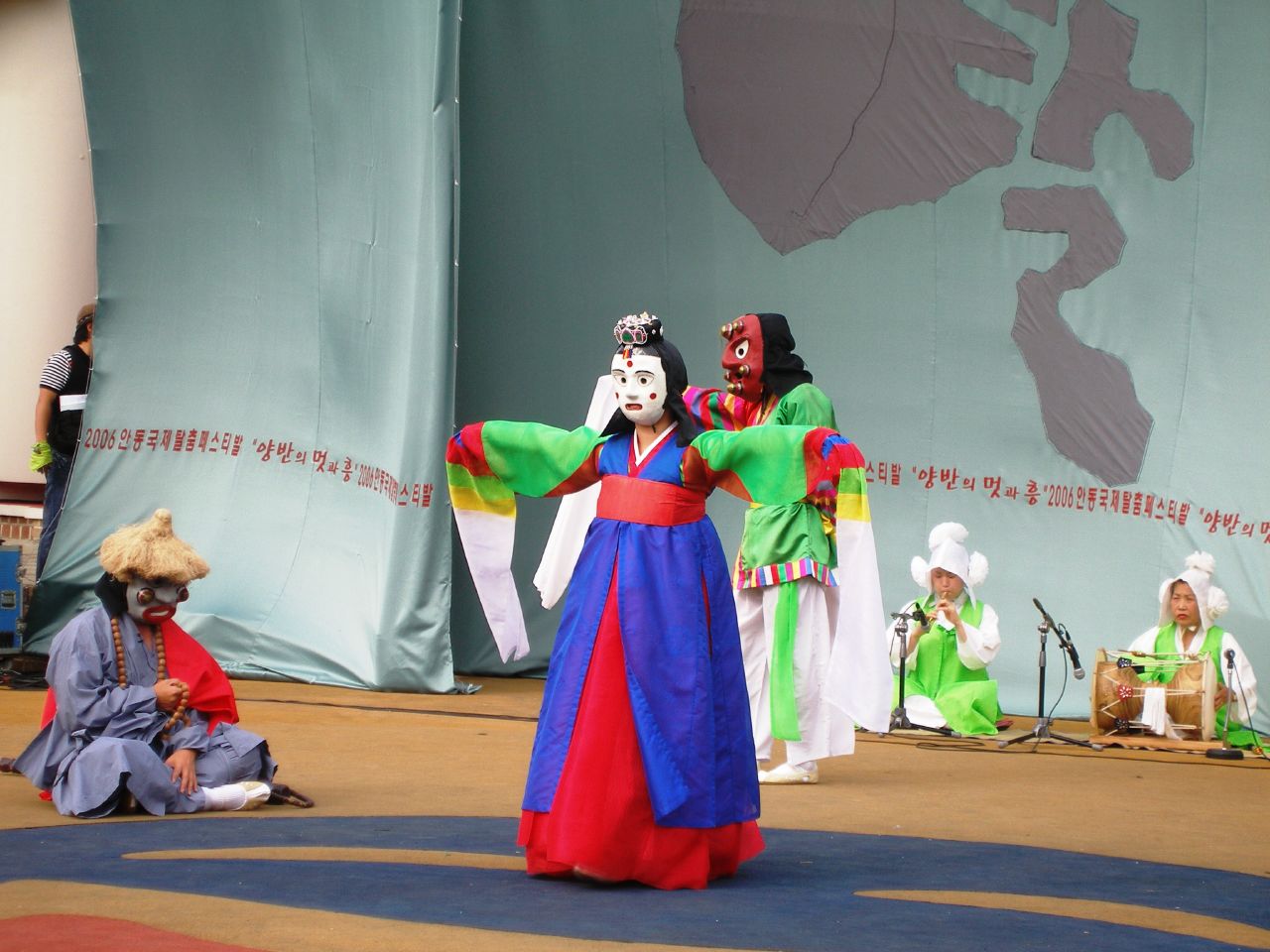

When and where Talchum is danced
Talchum is performed at major festivals like the First Full Moon, Buddha's Birthday, Dano, and Chuseok. It can also be part of rituals for rain or exorcism, and sometimes appears at state events or public celebrations. Performers may be villagers, troupes, or professionals, and the tradition is passed down through both community and family.
Styles of Talchum
There are about thirteen regional styles of talchum, each with its own stories, masks, and dance patterns. Well-known forms include Bongsan Talchum, Hahoe byeolsingut talnori, and Gangneung Gwanno Gamyeon'guk. Some styles focus more on ritual, others on satire or comedy, and each region adds its own flavor to the tradition.
What Talchum means
Talchum is valued as a symbol of Korean identity and creativity. It has long given voice to ordinary people, using humor and story to question authority and tradition. In 2022, UNESCO recognized talchum as Intangible Cultural Heritage, affirming its importance both locally and globally. The dance remains a living tradition, celebrated at festivals and studied as a cultural treasure.
Days Talchum is danced for
Questions people ask about Talchum
Where does talchum come from?
Talchum originated in Korean villages and has roots in shamanic rituals and folk traditions. It developed across regions like Hwanghae, Gyeonggi, and Gyeongsang provinces, each with its own style.
When is talchum performed?
Talchum is performed at major festivals such as the First Full Moon, Buddha's Birthday, Dano Festival, and Chuseok. It may also appear at rituals for rain or exorcism, and at public celebrations.
Who dances talchum?
Talchum can be danced by villagers, professional troupes, or community members. The cast and style can vary by region and occasion, with both men and women taking part in some versions.
What is special about talchum masks?
The masks represent a range of characters, from people and animals to supernatural beings. Each mask is crafted to show the character's role, and helps the dancer express emotion and story.
What are the main themes of talchum?
Talchum often satirizes the elite, mocks social evils, and includes ritual elements like exorcism. Stories may feature conflicts between classes, family drama, and mythical creatures.
Good reading and sources
- Talchum on WikipediaEncyclopedia
- More photos and video on Wikimedia CommonsPhotos and video
- Wikidata recordOpen data
- Videos of Talchum on YouTubeSearch results, not chosen by Ghungroo
The facts on this page come from the Wikipedia article "Talchum", written by its contributors and used under the CC BY-SA 4.0 licence, and from its Wikidata record (CC0). Ghungroo rewrote the text in its own words, with AI assistance, and compares every page with the article to make sure no passage is copied. It may be reused under the same CC BY-SA 4.0 licence with a link back.
It may contain mistakes, and it describes the dance in outline: it is not a lesson. Traditions differ from one teacher, village or family to the next. If something is wrong, tell us. Last refreshed 2026-10-03.
More from South Korea
All the dances of South Korea 🇰🇷 South Korea and 1 moreGanggangsullae강강술래
A Korean circle dance sung and danced by women under the full moonFolk dance · Circle · Line or chain
🇰🇷 South Korea and 1 moreGanggangsullae강강술래
A Korean circle dance sung and danced by women under the full moonFolk dance · Circle · Line or chain
 🇰🇷 South Korea and 2 morePungmul풍물
A Korean folk performance with drumming, dance, and song, rooted in farming lifeFolk dance · Group · Solo
🇰🇷 South Korea and 2 morePungmul풍물
A Korean folk performance with drumming, dance, and song, rooted in farming lifeFolk dance · Group · Solo
 🇰🇷 South KoreaBuchaechum부채춤
A group fan dance created in 1954, performed by women using large painted fans.Folk dance · Group
🇰🇷 South KoreaBuchaechum부채춤
A group fan dance created in 1954, performed by women using large painted fans.Folk dance · Group
 🇰🇷 South KoreaSeungmu승무 (僧舞)
A solo Korean dance with long white sleeves and a drum, tracing cosmic cycles.Ritual dance · Solo
🇰🇷 South KoreaSeungmu승무 (僧舞)
A solo Korean dance with long white sleeves and a drum, tracing cosmic cycles.Ritual dance · Solo
Its cousins elsewhere
All folk dances 🇪🇸 SpainFlamenco
A dramatic dance and music tradition rooted in Andalusia's gitano and folk culturesFolk dance · Solo · Group
🇪🇸 SpainFlamenco
A dramatic dance and music tradition rooted in Andalusia's gitano and folk culturesFolk dance · Solo · Group
 🇦🇷 Argentina and 1 moreTango
A partner dance from the Río de la Plata, danced in close or open embraceSocial dance · Couple
🇦🇷 Argentina and 1 moreTango
A partner dance from the Río de la Plata, danced in close or open embraceSocial dance · Couple
 🇦🇹 Austria and 4 moreWaltz
A turning couple dance in triple time, first popular in 18th-century EuropeBallroom or Latin dance · Couple
🇦🇹 Austria and 4 moreWaltz
A turning couple dance in triple time, first popular in 18th-century EuropeBallroom or Latin dance · Couple
 🇧🇷 BrazilCapoeira
A Brazilian martial art that blends dance, acrobatics, and music in a circle gameWar or martial dance · Circle · Solo
🇧🇷 BrazilCapoeira
A Brazilian martial art that blends dance, acrobatics, and music in a circle gameWar or martial dance · Circle · Solo