
Halay
A group dance in lines or circles, led by music or singing at weddings and celebrations
Halay is a communal dance from Turkey, performed in lines or circles by Turks, Kurds, Arabs, and Asia Minor Greeks. It is a key part of weddings and festive gatherings, often accompanied by zurna and davul or, at times, by the dancers' own singing. The pace starts slow and quickens, with local variations in steps and music.
Watch it dancedShare on WhatsApp
- Halay is widely danced at weddings in Turkey and Azerbaijan.
- Dancers may hold a handkerchief at the ends of the line.
- Music is often played on zurna and davul, or sung by the dancers.
- The dance tempo usually increases as it goes on.
- Each region has its own style and name for the dance.
What is Halay?
Halay is a traditional group dance from Turkey and neighboring regions, where people join in lines or circles, holding each other's hands, fingers, or shoulders. The dance is shared by several communities, including Turks, Kurds, Arabs, and Greeks of Asia Minor. It is a familiar sight at weddings and celebrations, with energetic footwork and a tempo that often increases as the dance goes on. The first and last dancers sometimes wave a handkerchief, adding to the visual rhythm.
Where does Halay come from?
The name halay is thought to come from the Turkish word for a group or crowd, itself linked to a Byzantine Greek term. Another theory connects it to a Kurdish word meaning 'to lift', though this is uncertain. The dance took shape in Central Anatolia in the early 1900s, influenced by Pontic Greek miners who brought a similar dance called Khalái. Over time, halay spread to other regions, each community adapting the steps and music to their own traditions. Written records of halay appear from the late 1920s and early 1930s.
How is Halay danced?
Dancers move together in a coordinated line or arc, often starting with slow steps that pick up speed. The group may hold hands, link fingers, or rest hands on each other's shoulders. Steps can include bending at the knees and rhythmic stamping, with patterns that differ from one place to another. The lead and tail dancers may hold a handkerchief, guiding the group through the dance. Each region has its own way of moving, but the sense of unity and shared rhythm is central.
Halay, drawn
The music of Halay
Traditional halay is played on the zurna, a piercing woodwind, and the davul, a large drum. In some areas, the violin or oud is used, and in Azerbaijan, the qoltuq nagara (a type of drum) is common. Sometimes, the dancers themselves sing as they move. In recent years, electronic instruments have also been used, especially in urban settings. The music usually starts at a measured pace and gradually builds in speed, matching the dancers' increasing energy.
Costume and what is carried
There is no single costume for halay, as dress varies by region and occasion. Dancers often wear their everyday clothes or local festive attire. The first and last dancers in the line may carry a handkerchief, called a mendil, which adds a flourish to their movements. No special footwear or uniform is required, and the focus is on the shared action rather than elaborate costume.
When and where Halay is danced
Halay is most often danced at weddings, but it is also seen at festivals and community gatherings. It brings together people of all ages and backgrounds, strengthening social bonds. In Azerbaijan, it is especially common at weddings, where guests may form a circle around the couple. The dance is passed down through families and local groups, and in some places, it is taught in schools to keep the tradition alive.
Styles of Halay
There are many local forms of halay, each with its own steps and musical style. In Turkey, versions like Elazığ dik halay, Üç Ayak, Kaba, Afshar, and Halabi are danced by different groups. Among Azerbaijanis, the dance is called yallı, with types such as Kochari, Tanzara, and Aghbaba Yallı. Each region adds its own flavor, but all share the basic pattern of group movement and rising tempo.
What Halay means
Halay is a symbol of togetherness and celebration for many communities in Turkey, Azerbaijan, and beyond. It plays a key role in marking important life events, especially weddings. The dance has survived changes in society and music, adapting to new instruments and settings. In some places, it is being revived after periods of decline, taught in schools and performed at cultural events as a way to keep local identity strong.
Questions people ask about Halay
Where does halay come from?
Halay developed in Central Anatolia, Turkey, in the early 20th century, influenced by Pontic Greek miners and local traditions. It later spread to other regions and communities.
When is halay usually danced?
Halay is most often performed at weddings and festive gatherings, but it can also be seen at community events and celebrations.
Who takes part in halay?
Both men and women join in halay, dancing together in lines or circles. People of all ages and backgrounds participate.
What music is used for halay?
Traditional halay music features the zurna (a woodwind) and davul (a drum), with regional variations including violin, oud, and qoltuq nagara. Sometimes, dancers sing instead of using instruments.
Are there different types of halay?
Yes, each region has its own style and version of halay, with different steps, music, and names. Examples include Elazığ dik halay, Üç Ayak, and yallı in Azerbaijan.
Good reading and sources
- Halay on WikipediaEncyclopedia
- More photos and video on Wikimedia CommonsPhotos and video
- Wikidata recordOpen data
- Videos of Halay on YouTubeSearch results, not chosen by EveryGhunghroo
The facts on this page come from the Wikipedia article "Halay", written by its contributors and used under the CC BY-SA 4.0 licence, and from its Wikidata record (CC0). EveryGhunghroo rewrote the text in its own words, with AI assistance, and compares every page with the article to make sure no passage is copied. It may be reused under the same CC BY-SA 4.0 licence with a link back.
It may contain mistakes, and it describes the dance in outline: it is not a lesson. Traditions differ from one teacher, village or family to the next. If something is wrong, tell us. Last refreshed 2026-10-03.
More from Turkey
All the dances of Turkey 🇪🇬 Egypt and 3 moreBelly danceرقص شرقي
A Middle Eastern dance focused on hip and torso articulation.Folk dance · Solo
🇹🇷 Turkey and 1 moreHasapikoχασάπικο
A two-speed Greek folk dance from Constantinople, first danced by its butchersFolk dance
🇪🇬 Egypt and 3 moreBelly danceرقص شرقي
A Middle Eastern dance focused on hip and torso articulation.Folk dance · Solo
🇹🇷 Turkey and 1 moreHasapikoχασάπικο
A two-speed Greek folk dance from Constantinople, first danced by its butchersFolk dance
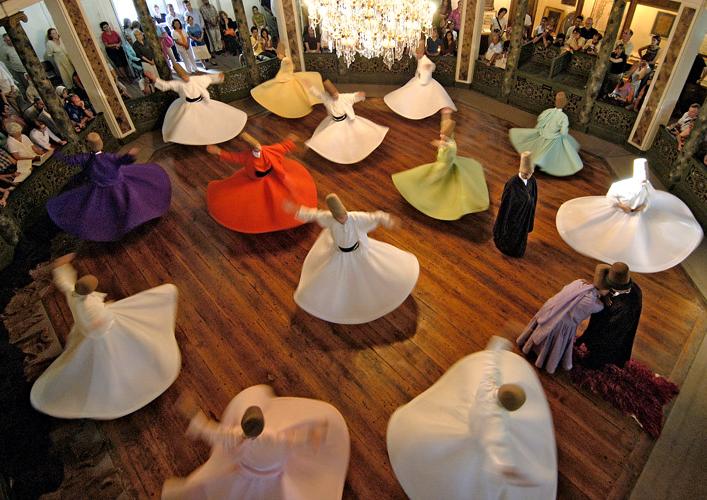 🇹🇷 Turkey and 3 moreSufi whirling
A meditative spinning dance practiced by Sufi dervishes during worship ceremoniesRitual dance · Solo · Group
🇹🇷 Turkey and 3 moreSufi whirling
A meditative spinning dance practiced by Sufi dervishes during worship ceremoniesRitual dance · Solo · Group
 🇰🇿 Kazakhstan and 3 moreKara JorgaQara jorğa
A Kazakh folk dance mimicking the ambling gait of a horse through rhythmic shoulder movements.Folk dance · Group · Solo
🇰🇿 Kazakhstan and 3 moreKara JorgaQara jorğa
A Kazakh folk dance mimicking the ambling gait of a horse through rhythmic shoulder movements.Folk dance · Group · Solo
Its cousins elsewhere
All folk dances 🇭🇺 Hungary and 5 moreCsárdás
A Hungarian folk dance that begins slowly and ends in a fast spin.Folk dance · Couple · Group
🇭🇺 Hungary and 5 moreCsárdás
A Hungarian folk dance that begins slowly and ends in a fast spin.Folk dance · Couple · Group
 🇫🇷 France and 3 moreBranle
A French chain dance of linked couples moving side to side, popular from the 1500s.Folk dance · Circle · Line or chain
🇫🇷 France and 3 moreBranle
A French chain dance of linked couples moving side to side, popular from the 1500s.Folk dance · Circle · Line or chain
 🇺🇦 Ukraine and 2 moreKolomyikaколомийка
A fast Ukrainian folk dance and song form from the Carpathian region.Folk dance · Group
🇬🇷 GreecePirgousikos
A Greek trio dance performed in a V shape for Carnival and weddingsFolk dance · Group · Set or square
🇺🇦 Ukraine and 2 moreKolomyikaколомийка
A fast Ukrainian folk dance and song form from the Carpathian region.Folk dance · Group
🇬🇷 GreecePirgousikos
A Greek trio dance performed in a V shape for Carnival and weddingsFolk dance · Group · Set or square