🇹🇷 The dances of Turkey
8 dances from Turkey, best known first, across 14 cities and regions.
Turkey's folk dancing is defined by line and circle formations that reflect its position at the crossroads of Europe and Asia. The traditions range from the solemn, grounded movements of the Aegean to the rapid, spinning steps of the Black Sea coast.
- Halay is a large group line dance common in eastern and southeastern Turkey.
- Horon from the Black Sea coast uses fast, circular steps and a 7/16 measure.
- Zeybek dances originate in the Aegean region and feature solo or group movements.
- Spoon dances around Konya use wooden utensils for rhythmic percussion.
- Davul and zurna are the standard instrument pair for many Turkish folk dances.
Dance in Turkey
Because Turkey sits between three seas and historic trade routes, its dance culture is highly varied. Most popular forms are group dances where people link hands or shoulders. These performances connect communities through shared rhythm and movement. The styles differ significantly depending on local history and geography. Some emphasize slow, dignified gestures while others focus on speed and agility. This diversity creates a rich tapestry of physical expression across the country.
Folk and regional dances 7 dances
The most recognizable forms include the Halay, performed in eastern and southeastern regions with linked arms, and the Horon of the Black Sea coast, known for fast, circular steps. In the west, Zeybek dances feature solo or small group movements with deep knee bends. Other notable types are the Spoon dances around Konya, using wooden utensils for percussion, and the Hora in Thrace. Each style has specific rhythmic patterns and regional costumes that distinguish it from others.
Ritual and ceremonial dance 3 dances
Samah is a ceremonial dance associated with Alevi-Bektashi communities. It involves singing without rhythmic instruments, often accompanied by stringed instruments like the baglama. The performance is structured in parts, including entertainment and symbolic acts involving cloaks. Historically rooted in spiritual practice, it maintains a solemn atmosphere distinct from festive folk gatherings.
Music and dress
The davul (large drum) and zurna (shrill pipe) are the primary accompaniment for many folk dances. The bağlama, a long-necked lute, supports faster tempos and melodic lines. In the Black Sea region, the cura (small zurna) and mey (bagpipe) drive the rapid pace of Horon. Wooden spoons create percussive rhythms in specific regional dances. Folk songs often accompany these instrumental arrangements.
From region to region
Eastern Anatolia favors Bar dances with side-by-side formations and complex 5/8 or 9/8 rhythms. The Black Sea coast features Horon, characterized by rapid shoulder movements and circular patterns influenced by Laz culture. Western Anatolia presents Zeybek, with its distinctive slow-to-fast tempo variations and grounded stance. Thrace incorporates Hora, reflecting Greek influences, while central areas show variations like Seymen. Local instruments and step styles define each zone.
Dance today
Folk dance remains a living tradition, taught in schools and performed at festivals. Organizations like the Folk Dance Federation of Turkey preserve these practices. Modern adaptations appear in urban centers, blending traditional steps with contemporary music. Revival efforts ensure that younger generations learn the regional styles. Cultural events continue to showcase the diversity of Turkish dance heritage.
The facts in this overview come from the Wikipedia article "Turkish folk dance", written by its contributors and used under the CC BY-SA 4.0 licence. Ghungroo rewrote the text in its own words, with AI assistance, and compares every page with the article to make sure no passage is copied. It may be reused under the same CC BY-SA 4.0 licence with a link back.
 🇪🇬 Egypt and 3 moreBelly danceرقص شرقي
A Middle Eastern dance focused on hip and torso articulation.Folk dance · Solo
🇹🇷 Turkey and 1 moreHasapikoχασάπικο
A two-speed Greek folk dance from Constantinople, first danced by its butchersFolk dance
🇪🇬 Egypt and 3 moreBelly danceرقص شرقي
A Middle Eastern dance focused on hip and torso articulation.Folk dance · Solo
🇹🇷 Turkey and 1 moreHasapikoχασάπικο
A two-speed Greek folk dance from Constantinople, first danced by its butchersFolk dance
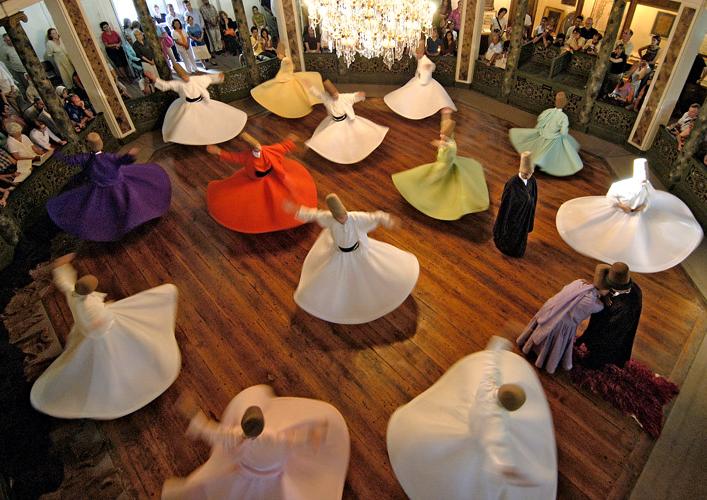 🇹🇷 Turkey and 3 moreSufi whirling
A meditative spinning dance practiced by Sufi dervishes during worship ceremoniesRitual dance · Solo · Group
🇹🇷 Turkey and 3 moreSufi whirling
A meditative spinning dance practiced by Sufi dervishes during worship ceremoniesRitual dance · Solo · Group
 🇹🇷 Turkey and 4 moreHalay
A group dance in lines or circles, led by music or singing at weddings and celebrationsFolk dance · Circle · Line or chain
🇹🇷 Turkey and 4 moreHalay
A group dance in lines or circles, led by music or singing at weddings and celebrationsFolk dance · Circle · Line or chain
 🇰🇿 Kazakhstan and 3 moreKara JorgaQara jorğa
A Kazakh folk dance mimicking the ambling gait of a horse through rhythmic shoulder movements.Folk dance · Group · Solo
🇰🇿 Kazakhstan and 3 moreKara JorgaQara jorğa
A Kazakh folk dance mimicking the ambling gait of a horse through rhythmic shoulder movements.Folk dance · Group · Solo
 🇹🇷 TurkeyHoronχορόν
A fast line dance from Turkey's Black Sea coast, known for its shoulder shimmy and sudden squats.Folk dance · Line or chain · Group
🇹🇷 Turkey and 3 moreSamaسَماع (samā)
A Sufi ritual of listening, prayer, and whirling dance to reach spiritual ecstasyRitual dance · Circle · Group
🇹🇷 TurkeyHoronχορόν
A fast line dance from Turkey's Black Sea coast, known for its shoulder shimmy and sudden squats.Folk dance · Line or chain · Group
🇹🇷 Turkey and 3 moreSamaسَماع (samā)
A Sufi ritual of listening, prayer, and whirling dance to reach spiritual ecstasyRitual dance · Circle · Group
 🇹🇷 TurkeyBar
A group folk dance from Eastern Anatolia, performed side-by-side with linked arms.Folk dance · Group
🇹🇷 TurkeyBar
A group folk dance from Eastern Anatolia, performed side-by-side with linked arms.Folk dance · Group
Photo credits on this page
The small pictures above come from Wikimedia Commons under free licences. Some are cropped to fit.
- Horon: Macukali, Public domain, source
- Bar: Maximilian Dörrbecker ( Chumwa ), CC BY-SA 2.5, source
- Raqs sharqi: 13th century artist, Public domain, source
- Kara Jorga: Ulan Alimbek, CC BY-SA 4.0, source
- Halay: Post of Moldova, Public domain, source
- Sufi whirling: myself, Public domain, source
Social and popular dance 1 dance
Dances like Kolbastı are popular among teenagers and young adults, serving as social bonding activities. Wedding celebrations often feature Karsilamas, a face-to-face dance with a lively tempo. These forms encourage participation and community interaction. They provide opportunities for people to meet, celebrate, and maintain social ties through shared physical activity and music.