
Horon
In its own language: χορόν
A fast line dance from Turkey's Black Sea coast, known for its shoulder shimmy and sudden squats.
Horon is a traditional folk dance from the Eastern Black Sea Region of Turkey. Dancers form a line or semicircle to perform rapid shoulder movements and quick squats, accompanied by instruments like the tulum bagpipe and kemenche fiddle.
Watch it dancedShare on WhatsApp
- Over 50 variations exist in one region.
- Features rapid shoulder shimmies and squats.
- Accompanied by tulum bagpipes and kemenche.
- Performed in lines or semicircles.
- Etymology links to ancient Greek chorus.
What is Horon?
Horon is a lively folk dance performed in the Eastern Black Sea Region of Turkey. It involves large groups of dancers arranged in a line or semicircle. The movement is defined by rapid shoulder shaking and full-body trembling. Dancers also execute sudden drops into a squat position. The performance requires significant speed and agility from every participant.
Where does Horon come from?
The word comes from the Greek term for dance. Its earliest recorded use in a Turkic language appears in a manuscript from 1303. In local provinces like Ordu and Giresun, people call it horan instead. Scholars link this style to ancient Greek armed dances. It shares similarities with the Pontian Greek serra war dance.
How is Horon danced?
Dancers stand in a row or curved line. They shake their shoulders quickly while trembling their entire bodies. A key feature is the sudden squatting motion. This requires strong legs and quick reflexes. The group moves together as a single unit through these sharp actions.
Horon, drawn
The music of Horon
The rhythm is driven by loud wind and percussion instruments. Musicians play the tulum, which is a type of bagpipe. They also use the kemenche, a bowed string instrument. Clarinets add melody to the mix. Large drums called davul and high-pitched zurna pipes provide the beat. Sometimes singers add vocal tunes.
Costume and what is carried
The sources do not describe specific clothing or accessories worn during the dance. Participants wear everyday attire suitable for active movement. No masks or special props are held in the hands.

When and where Horon is danced
People dance horon at weddings and engagement parties. It is also common at highland festivals. Military send-off ceremonies feature the dance as well. Both men and women participate. Some versions are for men only, while others include mixed groups.
Styles of Horon
More than fifty different styles exist within the same region. Each variation may have unique steps or musical accompaniment. The dance connects to broader traditions in the area. Similar forms appear among neighboring ethnic groups.
What Horon means
Horon represents the cultural identity of the Black Sea communities. It preserves ancient movement patterns linked to historical war dances. The dance remains a central part of local celebrations today.
Questions people ask about Horon
Where does Horon come from?
It originates in the Eastern Black Sea Region of Turkey, particularly around Ordu and Giresun.
What makes the movement unique?
Dancers perform fast shoulder shakes and sudden squats while moving in a line or semicircle.
When is it danced?
It is performed at weddings, engagements, highland festivals, and military send-offs.
What instruments accompany it?
Musicians play the tulum bagpipe, kemenche fiddle, clarinet, davul drum, and zurna pipe.
Good reading and sources
- Horon on WikipediaEncyclopedia
- Wikidata recordOpen data
- Videos of Horon on YouTubeSearch results, not chosen by Ghungroo
The facts on this page come from the Wikipedia article "Horon", written by its contributors and used under the CC BY-SA 4.0 licence, and from its Wikidata record (CC0). Ghungroo rewrote the text in its own words, with AI assistance, and compares every page with the article to make sure no passage is copied. It may be reused under the same CC BY-SA 4.0 licence with a link back.
It may contain mistakes, and it describes the dance in outline: it is not a lesson. Traditions differ from one teacher, village or family to the next. If something is wrong, tell us. Last refreshed 2026-10-03.
More from Turkey
All the dances of Turkey 🇪🇬 Egypt and 3 moreBelly danceرقص شرقي
A Middle Eastern dance focused on hip and torso articulation.Folk dance · Solo
🇹🇷 Turkey and 1 moreHasapikoχασάπικο
A two-speed Greek folk dance from Constantinople, first danced by its butchersFolk dance
🇪🇬 Egypt and 3 moreBelly danceرقص شرقي
A Middle Eastern dance focused on hip and torso articulation.Folk dance · Solo
🇹🇷 Turkey and 1 moreHasapikoχασάπικο
A two-speed Greek folk dance from Constantinople, first danced by its butchersFolk dance
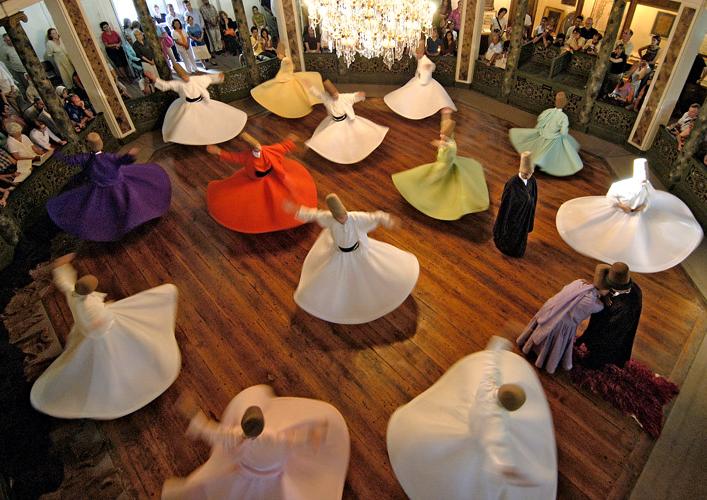 🇹🇷 Turkey and 3 moreSufi whirling
A meditative spinning dance practiced by Sufi dervishes during worship ceremoniesRitual dance · Solo · Group
🇹🇷 Turkey and 3 moreSufi whirling
A meditative spinning dance practiced by Sufi dervishes during worship ceremoniesRitual dance · Solo · Group
 🇹🇷 Turkey and 4 moreHalay
A group dance in lines or circles, led by music or singing at weddings and celebrationsFolk dance · Circle · Line or chain
🇹🇷 Turkey and 4 moreHalay
A group dance in lines or circles, led by music or singing at weddings and celebrationsFolk dance · Circle · Line or chain
Its cousins elsewhere
All folk dances 🇨🇿 Czech Republic and 5 morePolka
A lively partner dance in 2/4 time from 19th-century BohemiaFolk dance · Couple · Circle
🇨🇿 Czech Republic and 5 morePolka
A lively partner dance in 2/4 time from 19th-century BohemiaFolk dance · Couple · Circle
 🇮🇹 Italy and 2 moreTarantella
A fast southern Italian folk dance in six-eight time, accompanied by tambourines and hand clapping.Folk dance · Solo · Couple
🇮🇹 Italy and 2 moreTarantella
A fast southern Italian folk dance in six-eight time, accompanied by tambourines and hand clapping.Folk dance · Solo · Couple
 🇨🇺 Cuba and 5 moreContradanzacontradanza criolla
A Cuban partner dance with African rhythms that influenced jazz and tangoFolk dance · Couple
🇨🇺 Cuba and 5 moreContradanzacontradanza criolla
A Cuban partner dance with African rhythms that influenced jazz and tangoFolk dance · Couple
 🇲🇽 MexicoDanza de los Viejitos
A comic folk dance from Michoacán, performed by men in old men's masks and hatsFolk dance · Group
🇲🇽 MexicoDanza de los Viejitos
A comic folk dance from Michoacán, performed by men in old men's masks and hatsFolk dance · Group