Pembe
In its own language: Пембе
A hand-in-hand circle dance from Veles that starts slow and quickens to the end
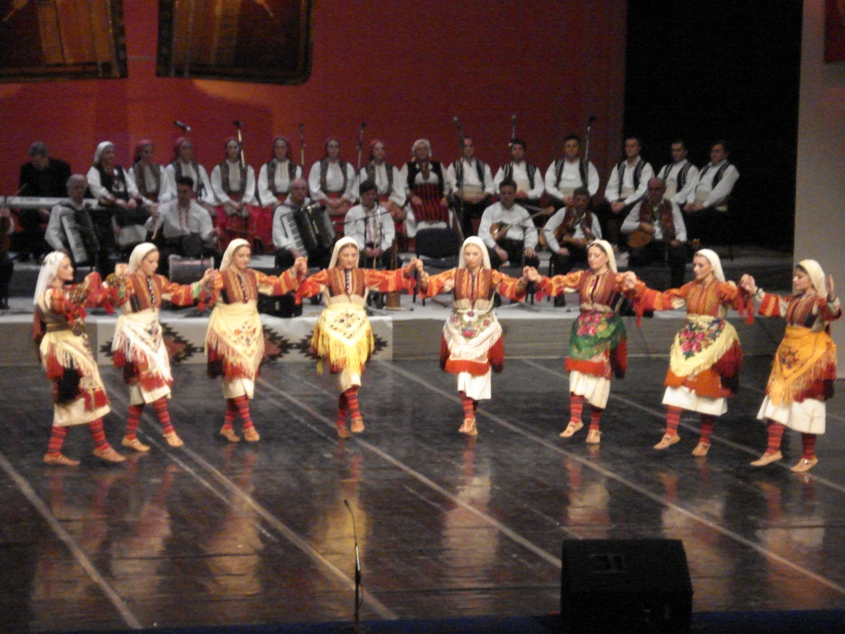
Pembe is a Macedonian oro, a circle dance, from the region of Veles in North Macedonia. Men and women dance it together, opening in a half circle with hands joined and raised to shoulder height, stepping on whole feet with a marked heel step, and quickening from a slow start to the end.
Watch it dancedShare on WhatsApp
- A Macedonian oro from Veles, danced by men and women together
- Hands stay joined and raised level with the shoulders throughout
- Steps land on whole feet, marked by a telling heel movement
- Starts slowly and keeps quickening until the end, in 2/4 time
- Recorded in Mihailo Dimovski's 1977 study of Macedonian folk dances
What is Pembe?
Pembe is an oro, the Macedonian word for a circle dance, and it comes from the region of Veles in North Macedonia. Men and women dance it together in one line, curved at first into a half circle. Each dancer holds a neighbour's hand, and the hands stay raised, level with the shoulders, for the whole dance. The steps are even and steady, taken on whole feet rather than the balls of the feet, and the heels contribute their own marked figure, which is the dance's signature. The music runs on a two-beat rhythm. Every turn begins at a deliberate pace and keeps getting faster until the end.
Where does Pembe come from?
The sources put Pembe's home narrowly: the region of Veles, a city in North Macedonia, where it counts as one of the Macedonian oros. An oro is a circle dance, and Macedonian folklore keeps many of them, tied to particular towns and valleys. No date of origin, founding figure or legend is recorded for Pembe in the material here. Its documentation sits in the standard scholarship on Macedonian folk dance: Mihailo Dimovski's 1977 study, published in Skopje, is named as the place to read further.
How is Pembe danced?
Dancers take their places in a line that curves into a half circle, men and women mixed, each holding the hands of the people on either side. That hold never drops: it stays up at shoulder height from first step to last. The footwork is level and unhurried at the start, with weight taken on whole feet, so the line moves smoothly. The heels have a job of their own, a repeated, telling movement that gives the dance its character. Over the course of the dance the tempo climbs, slowly at first, until the final stretch moves at a brisk pace, all inside a steady two-beat rhythm.
Pembe, drawn
The music of Pembe
Pembe is counted in 2/4, a plain measure of two even beats. The one musical instruction the sources give concerns speed: the dance sets off slowly and keeps accelerating, so whoever plays for it must build the tempo alongside the dancers. Beyond the metre, the record here is quiet. No instruments, songs or players are named. The wider frame is the music of North Macedonia, to which the article points readers for more.
What Pembe means
Pembe is a small, local piece of Macedonian folklore rather than a national emblem: the sources claim no heritage listing, no stage career and no legends for it. Its identity lies in its address. Among the many Macedonian oros, this one belongs to Veles, and that is how it is named and known. It survives in the written record of the country's folk dances, cited in the standard 1977 study by Mihailo Dimovski, and in moving image: a performance of the Pembe oro circulates on YouTube. For anything more, the trail runs through the wider study of Macedonian dance and music.
Questions people ask about Pembe
Where does Pembe come from?
It is a Macedonian circle dance, an oro, from the region of Veles, a city in North Macedonia. That local tie is the whole of its recorded origin: no date, founder or legend is given, though it appears in standard studies of Macedonian folk dance.
Who dances Pembe?
Men and women dance it together in one mixed line. Each holds a neighbour's hands, kept raised at shoulder height, and the line begins curved into a half circle before the dance moves off.
Why and when is Pembe danced?
The sources tie it to no festival, season or rite. It is recorded simply as a folk dance of the Veles region in North Macedonia, part of the local oro repertoire, with its performance captured on film.
What makes its style distinctive?
Two things: the hold and the heels. Dancers keep their joined hands lifted level with the shoulders, and they step on whole feet with a marked, repeated heel movement. The pace also tells a story, starting slow and gathering speed to the finish.
What is the music like?
The dance runs on a 2/4 rhythm, two even beats to the bar. The tempo builds across the dance from a slow start to a quick finish. No particular instruments or songs are named in the sources.
Good reading and sources
- Pembe on WikipediaEncyclopedia
- Wikidata recordOpen data
- Videos of Pembe on YouTubeSearch results, not chosen by EveryGhunghroo
The facts on this page come from the Wikipedia article "Pembe", written by its contributors and used under the CC BY-SA 4.0 licence, and from its Wikidata record (CC0). EveryGhunghroo rewrote the text in its own words, with AI assistance, and compares every page with the article to make sure no passage is copied. It may be reused under the same CC BY-SA 4.0 licence with a link back.
It may contain mistakes, and it describes the dance in outline: it is not a lesson. Traditions differ from one teacher, village or family to the next. If something is wrong, tell us. Last refreshed 2026-10-04.
More from North Macedonia
All the dances of North Macedonia 🇷🇴 Romania and 3 moreCălușari
A springtime men's ritual dance with acrobatics and sticks from RomaniaFolk dance · Group · Circle
🇷🇴 Romania and 3 moreCălușari
A springtime men's ritual dance with acrobatics and sticks from RomaniaFolk dance · Group · Circle
 🇷🇴 Romania and 6 moreHora
A group circle dance found across Southeast Europe and in Jewish communitiesFolk dance · Circle · Line or chain
🇷🇴 Romania and 6 moreHora
A group circle dance found across Southeast Europe and in Jewish communitiesFolk dance · Circle · Line or chain
 🇷🇸 Serbia and 4 moreČoček
A Balkan folk dance with shifting rhythms, often played by Romani brass bandsFolk dance · Group
🇷🇸 Serbia and 4 moreČoček
A Balkan folk dance with shifting rhythms, often played by Romani brass bandsFolk dance · Group
 🇲🇰 North Macedonia and 1 moreTeškotoТешкото
A Macedonian oro line dance expressing hardship through slow precision and fast leaps.Folk dance · Line or chain
🇲🇰 North Macedonia and 1 moreTeškotoТешкото
A Macedonian oro line dance expressing hardship through slow precision and fast leaps.Folk dance · Line or chain
Its cousins elsewhere
All folk dances 🇮🇳 India and 1 moreFolk dance
Traditional group dances rooted in local life and passed down through generationsFolk dance · Group · Circle
🇮🇳 India and 1 moreFolk dance
Traditional group dances rooted in local life and passed down through generationsFolk dance · Group · Circle
 🇧🇷 BrazilCapoeira
A Brazilian martial art that blends dance, acrobatics, and music in a circle gameWar or martial dance · Circle · Solo
🇧🇷 BrazilCapoeira
A Brazilian martial art that blends dance, acrobatics, and music in a circle gameWar or martial dance · Circle · Solo
 🇪🇬 Egypt and 3 moreBelly danceرقص شرقي
A Middle Eastern dance focused on hip and torso articulation.Folk dance · Solo
🇪🇬 Egypt and 3 moreBelly danceرقص شرقي
A Middle Eastern dance focused on hip and torso articulation.Folk dance · Solo
 🇳🇿 New ZealandHaka
A ceremonial group dance from New Zealand featuring vigorous movement and chanted words.Folk dance · Group
🇳🇿 New ZealandHaka
A ceremonial group dance from New Zealand featuring vigorous movement and chanted words.Folk dance · Group