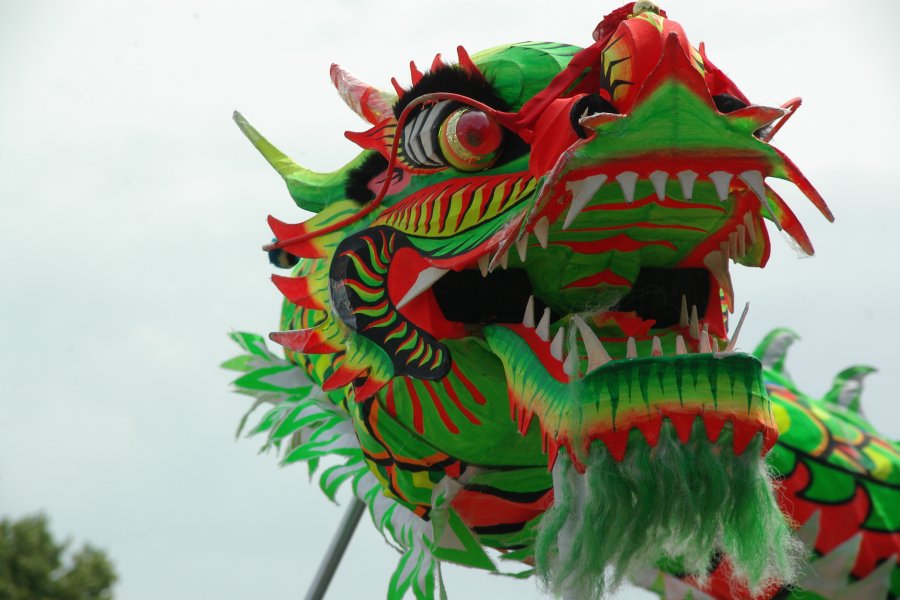
Dragon dance
In its own language: 舞龙 / 舞龍
A team dance with a giant dragon puppet, seen at Chinese New Year and festivals
Dragon dance is a traditional group performance from China, where dancers use poles to animate a long dragon puppet in flowing, wave-like patterns. It is most often performed during Chinese New Year and other festivities, with the dragon symbolizing luck, power, and prosperity. The dance is led by a 'pearl' and requires close teamwork to bring the dragon to life.
Watch it dancedShare on WhatsApp
- Dancers animate a long dragon puppet using poles
- The dragon chases a 'pearl' carried by a lead performer
- Performed at Chinese New Year and Lantern Festival
- Dragons can reach over 100 meters in length
- Regional styles use different materials and patterns
What is Dragon dance?
Dragon dance is a team performance where a group of dancers brings a large, flexible dragon puppet to life using poles attached along its length. The dragon, often brightly colored and decorated, moves in undulating, wave-like motions that mimic the imagined movements of the mythical creature. The dance is usually led by a performer carrying a 'pearl'—a ball on a pole—which the dragon appears to chase. The performance is lively and requires precise coordination among the dancers to create smooth, flowing patterns.
Where does Dragon dance come from?
The dragon dance traces back to ancient China, with early forms described during the Han dynasty. Originally, dances with dragon figures were part of rituals for rain, as dragons were linked to water and weather. Over centuries, the dance evolved, appearing in court entertainment and public festivals. Modern forms use lighter materials and more agile movements, promoted widely in China and overseas Chinese communities in the 20th century. Regional versions and innovations, such as human-chain dragons or dragons made from stools, show its local adaptation.
How is Dragon dance danced?
Dancers hold poles attached to sections of the dragon, moving in coordinated waves to give the impression of a living creature. The lead dancer guides the dragon’s head, often following a 'pearl,' while the rest of the team follows in sequence, creating curves, spirals, and other patterns. Complex routines may include moves like 'Cloud Cave' or 'dragon chasing the pearl,' with performers sometimes leaping over or through the dragon’s body. The success of the dance depends on teamwork and timing.
Dragon dance, drawn
The music of Dragon dance
The dance is accompanied by percussion, especially drums, which set the tempo and help synchronize the team's movements. The drumbeat matches the dragon’s actions, with faster rhythms for energetic sections and slower ones for dramatic effect. In some versions, additional instruments or gongs may be used, but the drum remains central. The music is loud and rhythmic, adding to the festive atmosphere.
Costume and what is carried
The dragon puppet is made of a lightweight frame, traditionally bamboo or wood, now often aluminium or plastic, and covered in colorful fabric. The head and tail are elaborately decorated, with scales and glittery details. Dancers usually wear matching team outfits, but the focus remains on the dragon itself. The 'pearl' is a decorated ball on a pole, carried by a lead performer.


When and where Dragon dance is danced
Dragon dance is most commonly performed during Chinese New Year and the Lantern Festival, but also appears at other celebrations and parades. It is danced by trained teams, often from local associations or schools, and sometimes in competition. The dance is passed down through practice and teamwork, with both adults and children taking part. Retired dragon puppets are often burned, as tradition holds.
Styles of Dragon dance
There are many regional styles, such as the cloth dragon from Zhejiang, human-chain dragons in Guangdong, and stool dragons in Pujiang. Dragons vary in length, color, and construction, with some built for agility and others for grand processions. Luminous dragons painted for black-light performances are used in competitions. Occasionally, double or nine-dragon dances are staged, involving multiple teams.
What Dragon dance means
The dragon is a symbol of luck, power, and dignity in Chinese culture, once representing imperial authority. The dance is believed to bring good fortune, with longer dragons thought to bring more luck. It is a key part of festival celebrations and a marker of Chinese identity, both in China and in overseas communities. Some historic dragon puppets are preserved in museums abroad.
Days Dragon dance is danced for
Questions people ask about Dragon dance
Where does the dragon dance come from?
Dragon dance originated in China, with early forms described during the Han dynasty. It has since spread to Chinese communities worldwide.
When is the dragon dance performed?
It is most often performed during Chinese New Year, the Lantern Festival, and other festive celebrations.
How is the dragon dance performed?
A team of dancers uses poles to move a long dragon puppet in wave-like patterns, often following a 'pearl' carried by a lead performer.
What does the dragon symbolize in the dance?
The dragon represents luck, power, dignity, and prosperity. The dance is believed to bring good fortune to the community.
Are there different styles of dragon dance?
Yes, there are many regional variations in China, with differences in dragon length, construction, and dance patterns.
Good reading and sources
- Dragon dance on WikipediaEncyclopedia
- More photos and video on Wikimedia CommonsPhotos and video
- Wikidata recordOpen data
- Videos of Dragon dance on YouTubeSearch results, not chosen by Ghungroo
The facts on this page come from the Wikipedia article "Dragon dance", written by its contributors and used under the CC BY-SA 4.0 licence, and from its Wikidata record (CC0). Ghungroo rewrote the text in its own words, with AI assistance, and compares every page with the article to make sure no passage is copied. It may be reused under the same CC BY-SA 4.0 licence with a link back.
It may contain mistakes, and it describes the dance in outline: it is not a lesson. Traditions differ from one teacher, village or family to the next. If something is wrong, tell us. Last refreshed 2026-10-03.
More from China
All the dances of China 🇨🇳 China and 5 moreLion dance舞獅
A costumed dance that mimics a lion to bring luck and drive away evilFolk dance · Group · Procession
🇨🇳 China and 5 moreLion dance舞獅
A costumed dance that mimics a lion to bring luck and drive away evilFolk dance · Group · Procession
 🇰🇷 South Korea and 2 morePungmul풍물
A Korean folk performance with drumming, dance, and song, rooted in farming lifeFolk dance · Group · Solo
🇰🇷 South Korea and 2 morePungmul풍물
A Korean folk performance with drumming, dance, and song, rooted in farming lifeFolk dance · Group · Solo
 🇨🇳 China and 6 morePeacock dance
A folk dance imitating the peacock, found across South and Southeast AsiaFolk dance · Solo · Group
🇨🇳 China and 6 morePeacock dance
A folk dance imitating the peacock, found across South and Southeast AsiaFolk dance · Solo · Group
 🇨🇳 ChinaYangge秧歌
A lively folk dance in lines or circles, often with ribbons, drums, and fansFolk dance · Line or chain · Circle
🇨🇳 ChinaYangge秧歌
A lively folk dance in lines or circles, often with ribbons, drums, and fansFolk dance · Line or chain · Circle
Its cousins elsewhere
All folk dances 🇧🇪 Belgium and 5 moreProcessional giant
Huge costumed figures carried and danced in European street processionsFolk dance · Solo · Procession
🇧🇪 Belgium and 5 moreProcessional giant
Huge costumed figures carried and danced in European street processionsFolk dance · Solo · Procession
 🇧🇧 BarbadosBarbados Land-ship
A parade and dance tradition in Barbados, mimicking naval maneuvers on landFolk dance · Group · Procession
🇧🇧 BarbadosBarbados Land-ship
A parade and dance tradition in Barbados, mimicking naval maneuvers on landFolk dance · Group · Procession
 🇫🇷 FranceFarandolefarandola
A long chain dance of Provence, led by a drummer with a tambourine and flute.Folk dance · Group
🇫🇷 FranceFarandolefarandola
A long chain dance of Provence, led by a drummer with a tambourine and flute.Folk dance · Group
 🇬🇧 United Kingdom and 5 moreMorris dance
A group folk dance from England, with bells, sticks or handkerchiefsFolk dance · Group · Procession
🇬🇧 United Kingdom and 5 moreMorris dance
A group folk dance from England, with bells, sticks or handkerchiefsFolk dance · Group · Procession