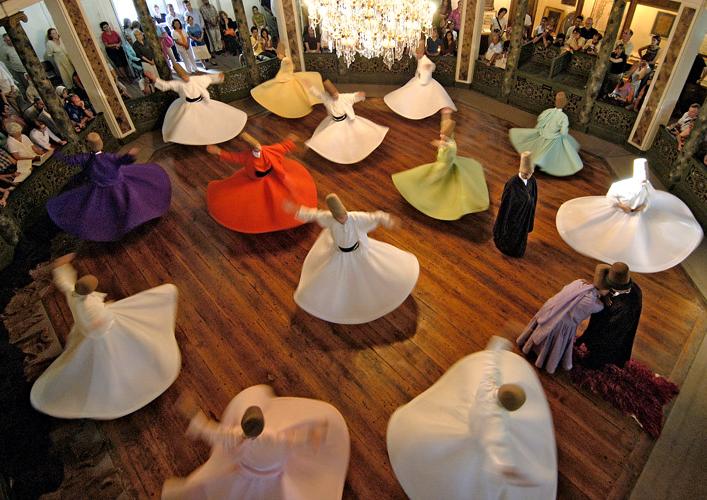
Sama
In its own language: سماع
A Sufi ritual of listening, prayer, and whirling dance in Turkey, Egypt, and Iran.
Sama is a Sufi devotional ceremony combining singing, poetry, and spinning dance to reach spiritual ecstasy. Originating in the thirteenth century with Rumi, it is performed by orders like the Mevlevi in Turkey, Alevi communities, and practitioners of Tannoura in Egypt.
Watch it dancedShare on WhatsApp
- UNESCO recognized the Mevlevi Sema Ceremony in 2005.
- Rumi started the practice after hearing goldbeaters in a market.
- Dancers seek fanaa, the loss of ego, through spinning.
- Alevi versions involve mixed groups and crane formations.
- Tannoura is the Egyptian folk and concert adaptation.
What is Sama?
Sama is a sacred ceremony practiced within Sufism, the mystical branch of Islam. The word means listening or hearing. It is a form of worship where participants use music, poetry, and movement to remember God. The most famous version involves dancers spinning in circles. This practice is designed to help the dancer lose their ego and connect directly with the divine presence. It is not just a performance but a deep spiritual exercise.
Where does Sama come from?
The ritual is credited to the poet and mystic Rumi in the thirteenth century. Legend says he heard goldbeaters hammering metal in a market and began spinning in joy. Another early figure, Abu Sa`id, introduced music and dance to devotional gatherings in Iran around the tenth century. The practice was later formalized by Rumi's son and Iranian students into the structured ceremony known today.
How is Sama danced?
Dancers move in a circle, often turning individually while maintaining group cohesion. In the Mevlevi tradition, adult initiates spin continuously. In Alevi ceremonies, participants may turn in pairs or small groups without full whirling. The movement symbolizes a journey from the self toward truth. Dancers aim for a state called fanaa, which is the annihilation of the ego, allowing them to serve creation with love.
Sama, drawn
The music of Sama
The ceremony relies on singing hymns called qawl and bayt. Instruments are used sparingly and must be symbolic rather than profane. Common tools include the ney (flute), tambourines, and bells. Poetry is recited to aid contemplation. Qur'anic verses are never set to music or improvised upon, preserving their sacred status. The rhythm supports the dancer's focus on God.
Costume and what is carried
Participants wear specific symbolic clothing that varies by order. The attire is part of the ritual's structure and meaning. In some traditions, the dress helps the dancer shed their worldly identity. The costume is essential for the visual representation of the spiritual ascent and the transition from the lower self to a higher state of being.


When and where Sama is danced
Sama is performed during religious gatherings and festivals. In Turkey, it is central to the Mevlevi Order and Alevi cemevleri (meeting houses). It is also danced at events like the Hacı Bektaş Veli Festival. In Egypt, a variation called Tannoura is performed as both a folk dance and a concert piece. The practice requires pure intent and silence from observers unless ecstasy occurs.
Styles of Sama
The Mevlevi style features individual whirling by male initiates. Alevi sema includes mixed groups of teenagers performing crane or forty-person formations. Tannoura in Egypt uses elaborate costumes and is often staged for audiences. Other Sufi orders have adapted the ritual to fit their own spiritual frameworks, creating distinct regional styles across the Middle East.
What Sama means
UNESCO listed the Mevlevi Sema Ceremony as a Masterpiece of Intangible Heritage in 2005. The practice faces controversy among some Muslim groups who view music as innovation. However, advocates argue it purifies the soul. Sama remains a key expression of Sufi identity and spiritual knowledge in Turkey and beyond.
Questions people ask about Sama
What does the name Sama mean?
Sama translates to listening or hearing. It refers to the act of listening to God through music, poetry, and the inner voice during the ritual.
Where did this dance originate?
It originated in the thirteenth century with Rumi in what is now Turkey. Earlier roots exist in tenth-century Iran with figures like Abu Sa`id who integrated music into devotion.
Why do dancers spin?
Spinning symbolizes a spiritual journey. The dancer sheds their ego (fanaa) and turns toward truth, aiming to return as a mature servant of creation.
Is it only for men?
No. While the Mevlevi order historically used only men, Alevi ceremonies feature mixed groups of teenagers. Tannoura in Egypt is performed by various dancers.
What instruments are used?
Common instruments include the flute, tambourine, and bells. Singing hymns is central. Profane instruments are avoided to maintain the sacred nature of the ceremony.
Good reading and sources
- Sama (Sufism) on WikipediaEncyclopedia
- Wikidata recordOpen data
- Videos of Sama on YouTubeSearch results, not chosen by Ghungroo
The facts on this page come from the Wikipedia article "Sama (Sufism)", written by its contributors and used under the CC BY-SA 4.0 licence, and from its Wikidata record (CC0). Ghungroo rewrote the text in its own words, with AI assistance, and compares every page with the article to make sure no passage is copied. It may be reused under the same CC BY-SA 4.0 licence with a link back.
It may contain mistakes, and it describes the dance in outline: it is not a lesson. Traditions differ from one teacher, village or family to the next. If something is wrong, tell us. Last refreshed 2026-10-04.
More from Turkey
All the dances of Turkey 🇪🇬 Egypt and 3 moreBelly danceرقص شرقي
A Middle Eastern dance focused on hip and torso articulation.Folk dance · Solo
🇹🇷 Turkey and 1 moreHasapikoχασάπικο
A two-speed Greek folk dance from Constantinople, first danced by its butchersFolk dance
🇹🇷 Turkey and 3 moreSufi whirling
A meditative spinning dance practiced by Sufi dervishes during worship ceremoniesRitual dance · Solo · Group
🇪🇬 Egypt and 3 moreBelly danceرقص شرقي
A Middle Eastern dance focused on hip and torso articulation.Folk dance · Solo
🇹🇷 Turkey and 1 moreHasapikoχασάπικο
A two-speed Greek folk dance from Constantinople, first danced by its butchersFolk dance
🇹🇷 Turkey and 3 moreSufi whirling
A meditative spinning dance practiced by Sufi dervishes during worship ceremoniesRitual dance · Solo · Group
 🇹🇷 Turkey and 4 moreHalay
A group dance in lines or circles, led by music or singing at weddings and celebrationsFolk dance · Circle · Line or chain
🇹🇷 Turkey and 4 moreHalay
A group dance in lines or circles, led by music or singing at weddings and celebrationsFolk dance · Circle · Line or chain
Its cousins elsewhere
All ritual and sacred dances 🇬🇷 Greece and 5 moreCircle dance
A group dance in a circle or curved line, joined by hand and led around the floorFolk dance · Circle · Line or chain
🇬🇷 Greece and 5 moreCircle dance
A group dance in a circle or curved line, joined by hand and led around the floorFolk dance · Circle · Line or chain
 🇺🇸 United States and 2 moreNative American Hoop Dance
A solo dance using multiple hoops to form shapes of animals and the cycle of life.Folk dance · Solo
🇺🇸 United States and 2 moreNative American Hoop Dance
A solo dance using multiple hoops to form shapes of animals and the cycle of life.Folk dance · Solo
 🇻🇪 VenezuelaDancing devils of Corpus ChristiDiablos danzantes de Corpus Christi
Masked dancers in red parade and perform on Corpus Christi in Venezuelan townsRitual dance · Procession · Group
🇻🇪 VenezuelaDancing devils of Corpus ChristiDiablos danzantes de Corpus Christi
Masked dancers in red parade and perform on Corpus Christi in Venezuelan townsRitual dance · Procession · Group
 🇧🇧 BarbadosBarbados Land-ship
A parade and dance tradition in Barbados, mimicking naval maneuvers on landFolk dance · Group · Procession
🇧🇧 BarbadosBarbados Land-ship
A parade and dance tradition in Barbados, mimicking naval maneuvers on landFolk dance · Group · Procession